
 Share on bsky
The Story of Layman P’ang, Reluctant Monk and Family Man.
My daily activities are not unusual,
I’m just naturally in harmony with them.
Grasping nothing, discarding nothing.
In every place there’s no hindrance, no conflict.
My supernatural power and marvelous activity:
Drawing water and chopping wood.
-P’ang
Layman P’ang is considered a model for the potential for non-monastic Buddhists. He lived in the 700s. He was a bureaucrat, working for the Chinese government. He got married and had two children, a daughter and then a son. One day, he just grew to become interested in spiritual matters. He built a little hermitage on his property and started spending time retreating there with his kids and meditating. His daughter Ling-chao was especially interested in the Dharma and studied it with him throughout his life.
P’ang studied with a Zen teacher named Sekito in a monastery called Nan-yueh for a year. Sekito put him through monk training, but ultimately P’ang refused to become a monk. He did not want to be ordained and to become part of the monastic structure. He was interested in the Dharma, but he wasn’t interested in being a monk. He left the monastery.
There is a famous dialogue between P’ang and Sekito.
Sekito asked, “How have you practiced Zen since coming here?” and P’ang replied, “My daily activities.”
P’ang traveled to a place called Kiangsi and studied with an even more famous Zen teacher named Baso. Once again, after studying for a year, Baso offered to make P’ang a monk. Again, P’ang refused. He did not want to be part of a hierarchy. He was a lot happier practicing Buddhism with his family and challenging the norm.
Becoming a monk was considered normal. He was unwilling to allow joining a Zen hierarchy to restrict his options. He wanted to live in a way that was open and free, not bound by the constraints of the system. He spent his time wandering from place to place, discussing spirituality with any who would listen. He spent as much time talking about the Dharma with the homeless and the working class as he did with monks and scholars. Free of monastic rules and hierarchical duties, we was able to challenge the best and brightest minds of his day.
He also wrote a great deal of poetry. Here’s a poem he wrote:
Well versed in the Buddha way, I go the non-Way.
Without abandoning my ordinary man’s affairs,
The conditioned name-and-form are all flowers in the sky.
Nameless and formless, I leave birth and death.
Layman P’ang is one of my favorite Zen teachers. He is the original Reluctant Monk. He was nervous about following authority figures so he made his own way. The Dharma does not have to adhere to a strict hierarchy.
Sometimes people become far too attached to tradition and customs and forget to focus on the Dharma at all. The Dharma is beyond such things. P’ang rebelled against the notion that he had to become a monk in order to spread the Dharma. In spite of being such a radical figure, and he really was quite radical in his day, he is beloved and revered today.
He practiced Buddhism with his children. I really connect with that. Like him, I have a son and a daughter. They are very interested in being involved in my practice with me as well.
So, Layman P’ang is one of my heroes. Maybe I just love anyone who is willing to challenge authority.
Like elephant Buddhadharma on Facebook.
{photo: via Herbvaceous Lady}
Ed: Sara Crolick
 Read 2 Comments and Reply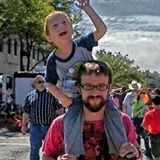





Read 2 comments and reply