

 Share on bsky
The Subtle, and Not So Subtle, at the Kumbh Mela
February 25, 2019
Prayagraj, Uttar Pradesh, India
Rest assured that at this very moment, millions of sadhus, swamis, gurus, yogis, priests, monks and pilgrims representing countless traditions are praying for you and our planet at the spiritually infamous Kumbh Mela. We are here as spiritual activists, focused on creating a field effect to awaken society’s higher levels of consciousness. I am one of them, called to participate in what potentially may the most potent effort to date in the history of subtle activism.
With one week left to go at this Mela, it appears we could use more help in reaching the objective: to shift consciousness from the Kali Yuga, the most depraved of the Vedic time cycles, to the Sattva Yuga, the most enlightened cycle of time. This is an invitation to It would join us virtually. Knowing more and visualizing what happens here may facilitate a connection with the stream of Mela consciousness.
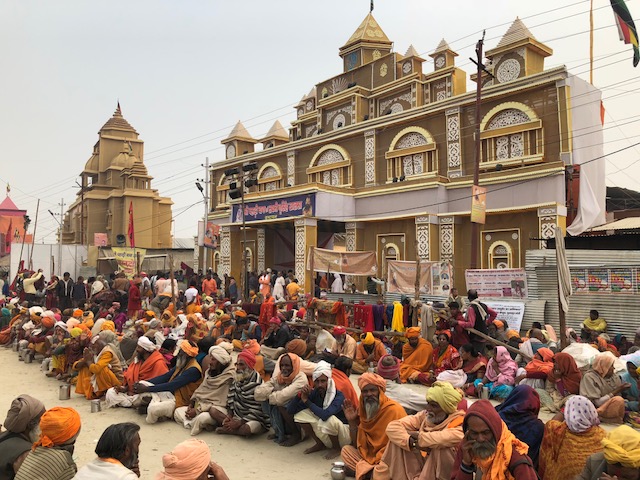
Picture this: at the sangam, the confluence of three sacred rivers in Northern India, there are temporary tent cities, pavilions, vendors, parking, bridges, bathing ghats and people stretching out over 12 square miles. This year’s crowd, expected to be 150 million, is more than the population of Russia and 50 times larger than England’s music festival at Glastonbury.
This is life at its best and worst. Intense numbers of people and vehicles create a powerful press of humanity. In order to avoid colliding with a motorbike or being stampeded by a crowd, we formulate our protective energetic bubble.
In order to get some sleep at night, we need to become one with the 24/7 Mela soundtrack, a conglomeration of otherworldly voices and frequencies, similar to what is heard in worst nightmares. Inevitably darkness appears on the path to enlightenment and we need to get through it in order to get over it.
More challenges lie ahead. Everywhere, exotic fragrances and putrid scents mix with bright smiles emerging from saffron, red and gold robes; but the dark haze of tainted air urges important inquiries.
To Breathe, Not to Breathe, or How to Breathe?
Concerns about air quality were the “elephant in the room” at this Mela. Evidently, the air was clear at the 2013 Mela, but we all have witnessed what 6 year’s worth of continued assault on our planet has had on livability.
Flying into Varanasi, India’s City of Light, made my jaw drop. A thick and deep gray swath obscured the land below. At the Mela, on the ground looking up, the sun is rarely visible and the skies have an unfamiliar cloud cover, one saturated with pollutants. Seen by satellites, this is known as the Asian brown cloud. An unidentifiable metallic presence is in the air. Some sense this as burning plastic or garbage. Wind nor rain have not dissipated the smoke.
All ages of people hack and cough constantly. At practice, it is disturbing to see yogis wearing face masks, scarves and bandanas. Questions such as “Is it best to breathe deep or shallow in these circumstances? Will breathingujjai or kabalabhati pranayamaendanger our lungs? What effect will this air have on my health? How bad is this? Should we really even be here?” are not addressed.
I learned that Varanasi has the 3rdworst air pollution in India (Delhi is 6th) and that Indian pulmonologists consider the effects of rampant air pollution as a national health emergency.
News reports published in mid-January indicated that there were two air quality collection stations at the Mela; one mobile, the other stationed at the center of Prayaraj. It was reported that air quality levels were 6 times higher than what the World Health Organization considers acceptable, a level of fine particulate matter of 150. Levels at the early stages of the Mela were measuring 500-800. No warnings are issued at the Mela.
To Dip or Not to Dip in the Ganges?
The goal for most Mela participants is to take a holy dip in the Ganges, which purifies the soul, breaks the karmic cycle and leads to liberation. Ever since Westerners first started attending, the top-of-mind question has been whether or not the water of the Ganges is safe. In 1896, Mark Twain addressed this question in a chapter “Ganges, the Great Purifier” in his book Following the Equator. He cites the scientific research of a Mr. Henkin, employed by the government of Agra, that showed cholera and other germs dying within six hours after contact with Ganges holy water. It was proven that these active agents, named “bacteriophage,” attack bacteria and are found in high levels in the holy river.
Today, the brown, chunky fluid flowing in the river is only imagined as water. Reports of amoebas, giardia and liver infections are common, as are claims of the Ganges’ healing properties (Brahm Dravya).
The hosts at our encampment along the Ganges handled this concern deftly. Though Western bodies are not accustomed to the microbes in the Ganges, the fact that we are drinking pure well water sourced from deep below the Ganges does qualify as divine nectar of the Gods. By ritualizing every drink and tooth brushing, risking a dip in the Ganges felt unnecessary.
Will our chants and prayers have an impact on environmental challenges?
Questions persist. Who and why was there no further news on the topic of air pollution at the Mela? Were more air samples taken? Is the water ever tested? What can affordably be done to improve the air and water quality? Will authorities mitigate the problem before the next Mela, 6 years from now? How can degradation of our natural resources become a higher priority? Rest assured, some of us, when not meditating, continue to monitor the situation.
KUMBH MELA AT A GLANCE
MEANING:
Great festival of the pot of nectar of immortality
WHAT:
Largest congregation of humanity, ever
ORIGIN:
According to Hindu scripture, thousands of years ago a sacred elixir of immortality (amrita) spilled from a pitcher (kumbh) during a celestial struggle between demons and gods. The elixir fell on four sacred river cities that now alternately host the Kumbh Mela:
Allahabad (Prayag)
Haridwar
Ujjain
Nasik
FREQUENCY:
Occurring four times during an astrologically determined 12-year cycle, each two-month long mela (‘gathering’) commemorates an ancient Hindu story.
Maha: (greatest), every 12 years
Ardha: (half) every 6 years, the cycle being celebrated now
LOCATIONS:
Prayag – near the city of Allahabad, in the state of Uttar Pradesh, at the confluence of three rivers Ganga (Ganges), Yamuna and mythical Saraswati, considered to be the spot where Brahma offered his first sacrifice after creating the world.
Haridwar -in the state of Uttaranchal Pradesh, where the river Ganga enters the plains from Himalayas.
Ujjain -in Madhya Pradesh, on the banks of Ksipra river
Nasik-in Maharashtra, on the banks of Godavari river
ACTIVITIES:
Pilgrims come to perform bathing rituals at these sanctified locations to wash away sins, hasten the breaking free from samsara (the cycle of reincarnation) to achieve moksha the final unification with the universal God, Brahman.
Pilgrims are acquiring knowledge from their teachers, i.e., swamis, gurus, sadhus and leaders, giving alms, chanting and practicing meditation to further their spiritual quest.
2019 BATHING DATES:
Makar Sankranti – January 14-15
Paush Purnima – January 21
Mauni Amavasya Feburary 4
Basant Panchami – Feb 10
Maghi Poornima – February 19
Maha Shivratri – March 4
 Leave a Thoughtful Comment





Read 0 comments and reply