 Share on bsky
تھدمت واللہ ارکان الھدیٰ
Translation: A pillar of guidance has fallen today.
When I encounter literature about Ali Ibn Abi Talib, I am forced to feel diverse emotions. Here I am not referring to religious literature but the literary art. Ali’s monumental figure is used as a metaphor in thousands of poems, songs, stories and fables. Hundreds of saints especially the Sufis of subcontinent have written various aspects of this larger than life human being, the saint of the saints.
From the dramatic description of his birth inside the Ka’aba to the picturesque painting of his valour during wars with special references to his sword the “Zulfiqar” and his horse, to his political conflicts, and his years of thorn and dust, to his utter loneliness and finally his excruciating death scene, everything is very well preserved in poetry,stories and paintings.
From Shams Tabriz, Rumi, Salman Herat, Ali Reza Gheznavi, Mousavi Garmaroudi, Gheysar Aminopour to our very own Osman Marwandi aka Lal shahbaz qalandar have written the most beautiful verses in his honour:
1. “Tonight the kind palm bent over the moon and it became dark
In a home that is far, a widow groaned
My child’s playmate has gone away”
(Aminpour)
One of the topics discussed in resistance poetry is Ali’s loneliness. A valiant soldier of the battles talks to wells, this is such a moving and agonizing aspect of his life used to describe his spiritual and intellectual loneliness and a poet or story-teller could hardly overlook it because of the deep impact this scene can create in poetry and a “Hikaayat”.
2. “Who has seen a sea cry in a well?
Who has seen the sun to take its half by himself?
It is worth mourning to see beauty pushed into darkness.” (Deliria)
This article would be incomplete without mentioning Shams Tabriz’s most beautiful literary tribute to God’s lion:
شاہِ شریعتم علی، پیرِ طریقتم علی
حق بہ علی حقیقتم، دم ہمہ دم علی علی
Imam of my shariah is ALI and Imam of my tariqah is ALI
with my every breath comes ALI ALI ALI.
ساقیِ با وفا منم، دم ہمہ دم علی علی
صوفیِ باصفامنم، دم ہمہ دم علی علی
A humble poet, I am, Let me be your muse drink of me
In rapture, my very being cries out: Ali Ali
A Sufi, I am, Pure of heart
In rapture, my very being cries out: Ali Ali
اشکِ مرتضیٰ منم، دم ہمہ دم علی علی
مطربِ خوش نوا منم، دم ہمہ دم علی علی
A lover, I am, of Murtaza Ali
In rapture, my very being cries out: Ali Ali
My joy uncontained, I am in song
In rapture, my very being cries out: Ali Ali
آدم با صفا توئ، یوسفِ ماہ لقاء توئ
خضرِ راہِ خدا توئ، دم ہمہ دم علی علی
Adam the Pure be you,
Yusuf the Beautiful too
Tis you who’s the Khizer(guide) of God’s path
In rapture, my very being cries out: Ali Ali
آیہء اِنّما برت، تاج ز لا فتیٰ سرت
شمس غلامُِ قنبرت،دم ہمہ دم علی علی
You are the Guardian, the Master of believers
Garbed, Crowned, Invincible, Unvanquished
I Shams, am a humble servant of your servant (Qanbar)
In rapture, my very being cries out: Ali Ali
Among poets no one like Ostad Shahriar could express Ali’s persona better. The famous sonnet “Ali ey homay-e-Rahmat” is one of the master pieces of Persian poetry, also adapted as a song which is available online and part of my “Zikr-e-Ali” playlist routine. I’m sharing an excerpt of Homay-e-Rahmat:
علي اي هماي رحمت تو چه آيتي خدا را
که به ماسوا فکندي همه سايهي هما را
O Ali! the bird of bliss, what a portent of God
For, thy shadow hast over-shadowed one and all
دل اگر خداشناسي همه در رخ علي بين
به علي شناختم به خدا قسم خدا را
O heart! If thou art Gog-gnostic, seek every thing in Ali`simage
By God , I came to know God by the very Ali indeed
به خدا که در دو عالم اثر از فنا نماند
چو علي گرفته باشد سر چشمهي بقا را
By God in the two universes no trace doth remain of mortality
Cos Ali hast occupied the source of eternity
بجز از علي که گويد به پسر که قاتل من
چو اسير تست اکنون به اسير کن مدارا
Nobody save Ali would order his son to be kind to his murderer
While he is thy captive
In Rumi’s famed masnavi, he has beautifully described the fable of the war where Ali drops his sword even though the enemy is under it. Despite being provoked Ali’s demeanor remains calm as he utters his words like a hero:
“I’m not under the obligation of my body.”
That last account is immortalized in the poetry of Mawlana Rumi, the famed mystic whose first book of the Masnavi ends with an account of Imam Ali. (See picture)
“I am a mountain, God’s my solid base,
Like straw I’m blown just by thought of His face;
My longing changes once His wind has blown,
My captain is the love of Him alone.”
(Rumi on Imam Ali)
One of the topics that the poets paid much attention to it would be Ali’s assassination. They tried hard to analyze this night from different aspects.
Sabzewari expressed the night as:
3. “Kufa was full of sadness and regret
Ali was full of sorrow, neglected from everything
Kufa was dumb and stupid, the night was fearful of the coming morning
Not the sedition formed”
We read about him in works of Allama Iqbal, Josh Malihabaadi, Jaun Eliya, Mir Anees and ofcourse Ali’s “jaanisar” Mohsin Naqvi.
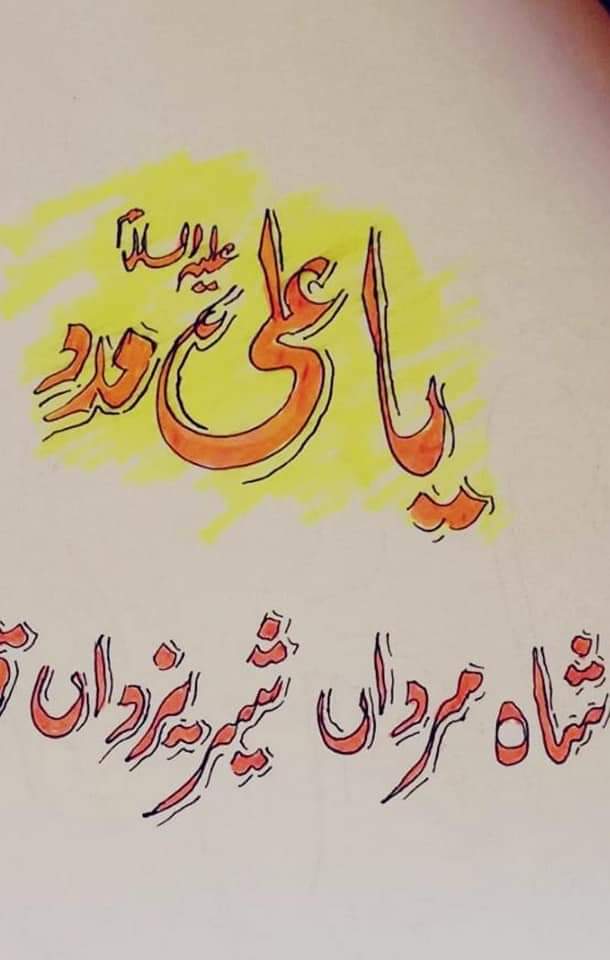
One of my personal favourites and all time classic written by Osman Marwandi and passionately sung by Nusrat Fateh Ali Khan with the additional Urdu verses is:
شاہ مردانِ علی
Another one is Haiderium, a modern qawwali sung in Nescafé basement.
You can play these on loop and lose yourself in a world where you have a sweet companion, Ali himself.
Ali was an undisputed master of eloquence, and one of the most eloquent documents in all of Arabic literature is traced back to him: the Nahj al-Balagha (“Peak of Eloquence”).
His last words are not only heroic but somewhat poetic and a last dialogue of an epic story after which the curtain falls and the hero wraps his immortal character.
فزت ورب الکعبۃ
“By the Lord of the Ka’aba, I am successful.”
Doesn’t it sound like an epic end to a story? Surely, such characters are written by the divine hands.
Share your opinion about the literary use of Mola Ali as a metaphor in poems and stories. Also share your favourite song/qawwali/poem/story written for him.
If you have written anything for Mola Ali, I’d love to read it because I’m quite passionate about the literature written for him.?
Here’s one sample of many tribute verses I wrote for him:
“The morning called “Ali” after he was struck
Every morning since then is calling his name
Kufa regrets, even the dagger cried,
“Ali! You did not deserve this pain.”
(Kanwal Batool)
Thank you for reading! Here’s a token of appreciation for you. ??✨
Ramzan 21, 1441 AH.
Lot’s of love,
KB~
 Read 8 Comments and Reply




Read 8 comments and reply