

 Share on bsky
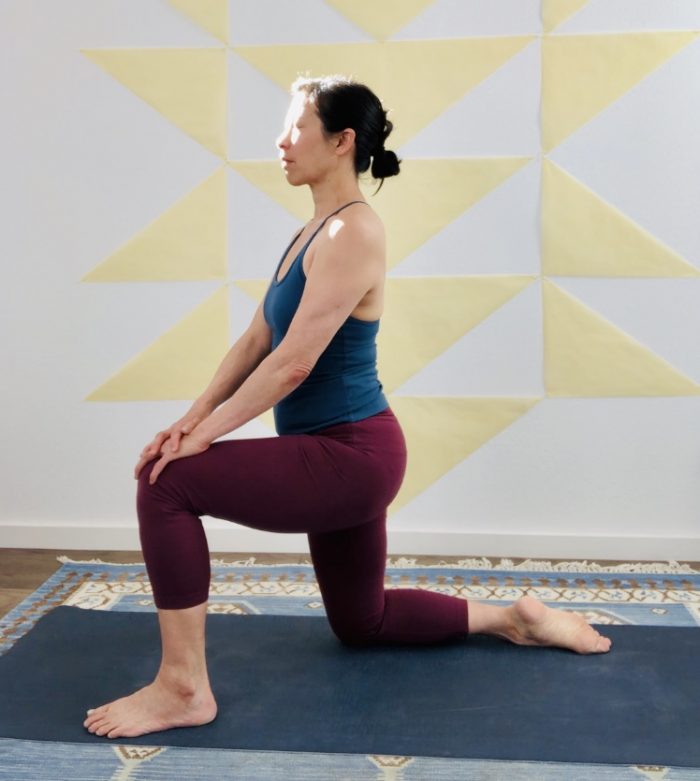
In a virtual yoga class June 4 at YogaSource in Santa Fe, one of my beloved local teachers, Edie Tsong, (pictured) guided us into a long-held Warrior series inviting the understanding that “the pose itself is the message.” She asked us to find out, “What does the vessel of this pose have to teach you?” I felt the familiar sense of discomfort arise as the heat rose in my core; I remembered another teacher reminding me good naturedly, “If you feel really annoyed in challenging poses, that’s good—it could just be your kapha acting up.” The densest of the elemental doshas (constitutions) in Ayurvedic understanding, it occurs to me, mid-Warrior, perhaps this dynamic of stubbornness in the body is analogous to, even revealing of, the way white supremacy is upheld and the resistance we often feel in our bodies, particularly as white practitioners, to facing and addressing our implication in the pain it causes. In an article from The Chopra Center, the editors write, “Excess Kapha in the mind manifests as resistance to change and stubbornness. In the face of stress, the typical Kapha response is, ‘I don’t want to deal with it.’” (Sound familiar to anyone else? ? ) Of course, each of the doshas has their respective expressions of imbalance, just as we each have our own mashup of doshas and our go-to defenses. Layla F. Saad asks her readers to reflect on what defines our own “unique, personal brand of white supremacy,” among many other journaling and discussion prompts in Me and White Supremacy: Combat Racism, Change the World, and Become a Good Ancestor.
Robin Diangelo has coined this term “white fragility” to name the “range of defensive moves” often displayed by white people in the face of “even a minimum amount of racial stress.” As she explains in White Fragility: Why It’s So Hard for White People to Talk About Racism, “These moves include the outward display of emotions such as anger, fear, and guilt, and behaviors such as argumentation, silence, and leaving the stress-inducing situation.” Unsure how to assume a posture of receptive presence when encountering such pain, white fragility represents all the ways we squirm out of the asana (yoga pose), thereby avoiding the transformation it can offer us. While the legacy of whiteness gives us the responsibility to engage in dismantling the systems that perpetuate racialized trauma, the rich inheritance of the yoga lineage we’ve been gifted gives us the tools to show up as non-aggressive warriors for liberation. The power of addressing trauma through the body is deep and subtle. In My Grandmother’s Hands: Racialized Trauma and the Pathway to Mending Our Hearts and Bodies, Resmaa Menakem writes, “The body is where we fear, hope, and react; where we constrict and release; and where we reflexively fight, flee or freeze. If we are to upend the status quo of white-body supremacy, we must begin with our bodies.” Yet with the status quo of so many yoga studios being white-majority spaces, we need to be cautious that we don’t come to our mats to “relax back into the warm and familiar comfort of white supremacy,” in the words of Saad. “Of course, practices that keep the body and mind healthy are more important than ever right now,” writes Tracey Anne Duncan in the article, “‘Spiritual bypassing’ is the ‘all lives matter’ of the yoga world. Don’t buy it,” “but they should be used to help us cope sanely with reality instead giving us a way to pretend that we are all one type of divine being, able to somehow magically transcend the reality of racism.”
“The muscle memory of whiteness is strong,” cautioned Rev. Angel Kyodo Williams, black Zen teacher and co-author of Radical Dharma: Talking Race, Love, and Liberation, in an online “all people sit,” she led June 2, observed online as #BlackOutTuesday by many white would-be allies of the Black Lives Matter Movement in an effort to #AmplifyMelanatedVoices. She warned that when we’re not careful, this habit energy sets back in as a default setting. “The racial status quo is comfortable for white people, and we will not move forward in race relations if we remain comfortable,” writes Diangelo. White people have to be willing to give something up, Rev. Angel advised, “to refuse to trade our humanity [the full humanity of black people and people of color] for those privileges” that whiteness affords. Diangelo adds, “The key to moving forward is what we do with our discomfort.” Our yoga asanas, classes, and teachings can be an alchemical crucible for turning toward, sustaining, and investigating our discomfort, and awakening to where to go from there in our efforts to stop causing harm, and hopefully, become useful accomplices to the Black Lives Matter movement as part of our dedication to the liberation of all beings. On their own, the limbs of yoga that are asana (yoga postures) and pranayama (breath-work) “act like a crystal in the being, and intensify the energy that we already carry,” says my teacher Wendelin Scott; this is why we need to work with the ethical framework of the yamas (social codes) and niyamas (self-disciplines) first, so we’re building upon and amplifying that foundation of nonviolence through our embodied practice.
Calling on the yogic practice of tapas, (austerity) as the heat that burns through impurities, can help us not to get stuck in discomfort and the difficult emotions of white fragility, to find the door on the other side of it and move through to embody solidarity. “We are here to step into the fire,” encourages Jessamyn Stanley when we move into chair pose in a workshop she is teaching. In her book Every Body Yoga she instructs the practice of tapas this way: “Build heat within yourself, via meditation or asana, in order to yield self-discipline and the ultimate sense of honesty.” Educating ourselves on how white supremacy functions as a system and is transmitted across generations, often without our awareness or conscious consent, can help us build stamina for eradicating the root causes of this suffering where they persist in our communities and culture. Unconscious bias and privilege, taught the late, great dharma teacher Cheri Maples, founder of the Center for Mindfulness and Justice, “is not our fault, but it is our responsibility.” Practicing with tapas in this way allows us to find the self-honesty to stay present for difficult self-reflection and conversation that shines much-needed light on where ignorance perpetuates the problem of racial injustice.
In a discussion of the Buddhist precept on not taking intoxicants at Upaya Zen Center, Pamela Ayo Yetunde offers the perspective of whiteness and its concomitant power and privilege as a poison that deludes the mind. We are addicted to white supremacy, she made me realize; we must detox from it, and make the lifelong commitment to sobriety. “The mind has been addicted to sense objects since time immemorial,” says Patañjali in the Yoga Sutras, (translated by Edwin F. Bryant) “and is caught up by them like a fish in a net. This primordial propensity cannot be destroyed without tapas, austerity.” With tapas we can destroy our addiction to the cultural conditioning that clouds our thinking with paradigms that uphold white supremacy.
On the mat as our training ground for relating to our discomfort and working with tapas, the breath can be a guide that points the way forward. My teacher’s teacher and one of the founders of Yoga Journal, Rama Jyoti Vernon, teaches us:
When you inhale, let it be a time of relaxation or doing nothing. The inspiration is a time to draw energies into yourself, to restore. On the exhalation, when the ego relinquishes or unravels itself, let the breath carry you deeper into the pose. Release a little more into the pose with each exhalation. As you come to an edge where pain arises, investigate its origin and its nature. Have you aligned with the pose? What does this pain reveal to you? Why is it there? What does it need from you for its own healing? On each exhalation, release more deeply into the pose and wait for a new understanding to reveal itself or a new door to open. (From her book Yoga: The Practice of Myth & Sacred Geometry.)
Our devotion to yoga practice is inextricable with our willingness to change, learn and grow into new understanding, and embody trust in its emergence. “Breathe a little bit of space between you and shame; you and fear. You don’t have to be shame or fear,” Rev. Angel told us. “Touch the pain whether it’s new or generations and generations old.” We can use the breath as an ally in this way anytime we notice reactivity arising within us around racial issues, reminding ourselves to hold the uncomfortable pose a bit longer, to wait for a new understanding to reveal itself, stoking the fires of transformation.
In our neighboring community of Taos, New Mexico, Afro-futurist artist and activist Nikesha Breeze led an action replicating similar “die-ins” happening around the country wherein participants laid on the ground, in prone sivasana, (corpse pose) with arms behind their back, for the length of time that George Floyd was murdered by asphyxiation, under the knee of police officer Derek Chauvin: eight minutes, 46 seconds. Breeze captioned a photo of this action, which shut down the main thoroughfare of the town, “This action for me was about getting these allies to feel in their visceral body, the vulnerability and helplessness of that position, to have their own faces marked with the hot asphalt so that they can realize that you must put your own skin in this. There is no spectator. Your body will remember that feeling for your entire life. And when you get up and continue your life you will realize that George Floyd never did.” This type of embodiment can give us the time and space to deepen our empathy and color in our imagination of the full humanity of others. “Let this truth sink you’re your belly,” Rev. Angel asks, “that black lives must matter; that our humanity depends on it.” Poet Sonia Sanchez says, “We only hurt others when we fail to fully imagine them.” Leaders at the Buddhist Peace Fellowship also practice and teach modes of “compassionate confrontation” wherein white allies can leverage un-earned privilege in relation to police interactions at demonstrations by physically forming a front line barrier that protects black and brown people.
In Edie’s Somatics & Alignment class in Santa Fe on the day of George Floyd’s memorial service in Minneapolis, she guides us into a lunge posture, invoking the iconic stance of Colin Kaepernick. “The pose itself is the message. What does the vessel of this pose have to teach you?” We know yoga asana training is designed to make us both stronger and more flexible. The Yoga Sutras ask us to find both sthira and sukha, steadiness and ease, in each pose, as my teachers have impressed upon me. We need a “strong back and soft front,” Roshi Joan Halifax teaches, as we seek to embody compassion. Can we find the steadiness of integrity to the ethic of ahimsa, (nonviolence) and the flexible softness to question everything we’ve done before, being willing to give something up when we discover the impact of our actions undermines our best intentions? Edie also mentioned she would no longer end her classes with “Namaste,” responding to a growing understanding that the usage of it we’ve become accustomed to in Western yoga is culturally insensitive. In Yin Yoga, the action of consciously relaxing the muscles allows the deeper transformation of the layers of fascia that bind and glue our tissues together. As we explore what it means to decolonize our yoga practice and de-center whiteness, where else can we soften, or give something up, to allow structural change to affect our systems, at a deeper level, and more globally?
Instead of using the word “Namaste,” to send a message about the inherent divinity and goodness of all, I pictured all yoga practitioners around the country kneeling into Kaepernick’s asana, to embody this medicine of humility and the heartbreaking recognition of the truth of suffering borne by black and indigenous people and people of color. Like the bow of pressing hands together at heart center that we often use at the beginning and end of classes to honor the worth and dignity of all beings, and acknowledge the teacher in each of us, what transformation might emerge if we all “take a knee” of solidarity every time we practice, holding space for honoring and listening to black, indigenous, and people of color?
 Leave a Thoughtful Comment




Read 0 comments and reply