

 Share on bsky
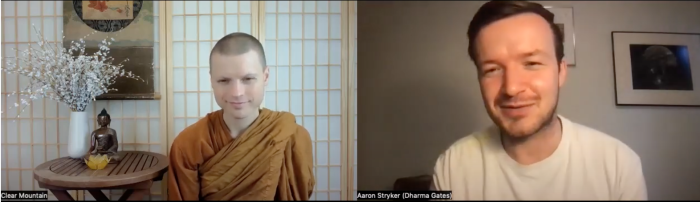
Aaron Strykker and Nisabho Bhikku, an ordained monastic in the Thai Forest tradition talk about all things ordination. They delve into Nisabho Bhikku’s story around monastic ordination, intentions and logistics of ordination, as well as the link between trauma and intensive practice. You can listen to their conversation here.
Aaron: I’m curious how you got to where you are right now particularly. What was the first contact point with this world of Buddhist practice and how did you end up sitting here in your mid-30s in robes?
Nisabho Bhikku: Thank you Aaron for having me on the Dharma Gates Podcast. It’s a really good intention of an organization. I think I could have benefited from something like it back in the day, but I was lucky enough to kind of stumble into this world without it.
Speaking to the question as to where I’m sitting right now, I’m actually in Seattle in a little hut basically for the last year and a half. I’ve been living here as a monk but then also seeing a community and a potential Monastery coalesce around the area called Clear Mountain. I moved here about a year and a half ago because this is where I grew up in the Northwest. I grew up in Spokane and read Siddhartha when I was 15 like every burgeoning hippie. Hermann Hess has a certain Lucidity around the tidal forces in a young person’s spirit and then my parents were sort of Buddhist-ish Buddhists, so I got introduced to some teachers through them. Then, when I was 15 and read that book I really intuited the vision of a monk in the form of the Buddha. That book really burned into me the need to take this path seriously so I began meditating daily.
That daily practice increased through attending college in Portland at Reed and Portland State, and then by the time I graduated I was meditating a significant amount every day and it was certainly the most important part of my life. I was basically looking at grad schools for Psychotherapy driving down the west coast and happened to stop by a monastery North of San Francisco called Abyaghiri in the Thai Forest tradition. Stepping into that environment of quiet after four days on the road listening to podcasts and listening to top 40 radio, and just distracting myself as I had been for three years or four years was very impactful. I knew that I needed the container of a monastic environment if I wasn’t going to dilute my life and live a life worthy of my death.
So, I saw a video of Luang Por Chah — Ajahn Chah — the progenitor of one of the current waves and lineages of the Thai Forest tradition on YouTube, and his demeanor struck me deeply. If people want to look that up, just search for “Ajahn Chah England” or something and you’ll see this interview with a being who has obviously encountered something profound. Wanting that, I spent a bit of time at a Tibetan monastery near where I grew up in Spokane called Srvasti Abbey but the Pali tradition always really resonated deeply with me in its simplicity and its clarity. Specifically, the Thai Forest brand — its strictness of Vinaya and intention to not handle money appeared as important structures in line with the Buddha’s original intention for the Sangha. I ended up going to a monastery in Thailand about ten years ago and was just really struck by the loving-kindness present there. Since then it’s been ordination and practicing in these Forest monasteries in different parts of the world. But always after that time in Thailand with these masters of another caliber, I felt called back to the West which feels kind of deep in my blood, seeing what might begin here.
So much of the Vinaya, from not storing food to not touching money is for the sake of keeping the monastics from cutting themselves off in a spiritual cocoon and being a daily presence in people’s lives. The idea that a monastery could be created in the U.S. in line with how they are in Thailand was really interesting to me so that’s been the last two years coming to Seattle. I live in a little hut offered by these wonderful lay practitioners. Every morning I go for alms around Pike Place in downtown Seattle. If you get food you get food and if you don’t, you don’t. But people have been very generous. We also meet in this Little Gym up in Capitol Hill and I’ve just been watching the community grow. For example, just last month we took about 30 of them to Thailand and Bodhgaya, India.
Aaron: So I guess I wanna backtrack a little bit because I know many other people at this point who have had some calling towards ordination but it can be a drawn-out and confusing process. So I’d be curious to hear about your experience. How did the call to ordain show up for you? What’s that inquiry process like, and what advice would you have for someone who’s living in that inquiry?
Nisabho Bhikku: I think many of us live with that sliver of a question in our hearts ever since we encounter the path. It’s like, what if someday I ordain? I think it’s an archetypal drive in a sense so it lives in a lot of us in a very good way. I mean it’s one lighthouse among many but it’s an important lighthouse for us as practitioners to have. I feel like it’s a helpful orientation to have. I started out practicing daily for half an hour and then over a few years beginning to up practice to maybe an hour a day and then an hour and a half a day. That daily input of conditions really changed my trajectory in a way that was very reliable, safe and beautiful. I think that the fluidity of my move towards robes was largely predicated on the fact that I was putting in those daily conditions of practice. That is all to say that when someone moves out of a difficult place in their life, not having really encountered the path much but then begins to read and gets a strong drive to just drop everything and go for it — not to say that one shouldn’t explore that but — it’s also okay to trust the slow accumulation of conditions in oneself. Those conditions sometimes do lead to other streams drying up and a sense of the triviality in one’s life, like a steady and subtle nausea from a misalignment with one’s true goal. For example, when I was in college I was doing good things but it never felt worthy of my death and I think death contemplations are really important to practice to undertake in order to clarify what one’s priorities are. What falls away in the face of that contemplation is everything that’s not really worthy of you. So I think when people begin to get interested in ordination, what I’ll usually advise people to do is not get too fixed on the robes right away, just go visit some monasteries. Often people just haven’t done that. I would encourage them to stay there for a weekend and then stay there for a week and then maybe go back to work. You don’t have to quit right away. In the Thai Forrest tradition, I would suggest visiting Abyaghiri in California and Temple Forest Monastery in New Hampshire. There are other places but those are two really good touchstones. The thing is so many of these decisions are far too large and karmically weighted to be resolved through thought. It’s an intuition in the body and that means you have to go there and feel it and see what karmic conditions will open and so often three or four days even at a monastery will clarify everything. It’s possible you have these really deep intuitions which have been waiting and suddenly there they are. I also find that getting a feel of the landscape and what it means to exist in that the karmic resonance really does hit and they find themselves less and less interested in their job and then I think it’s okay to take a leap and quit the job. But I would encourage a “dharmic field trip”. Maybe you don’t know exactly what lineage you’re interested in. Maybe you have some resonance with certain Mahayana teachings at the same time you love a certain clarity in another tradition. You don’t have to decide right away. Go have some fun in terms of visiting different monasteries. The worst that’s going to happen is you get to spend time at monasteries with great teachers and get all these beautiful connections. For a dharmic field trip I would advise you to check out the following monasteries in the U.S:
- Abyaghiri Temple in California
- Empty Cloud Monastery in Newark, New Jersey
- Watt Mettā in Valley Center, California
- Deer Park, Thich Nhat Hanh’s community in San Diego, California
- Blue Cliff, Thich Nhat Hanh’s community in Pine Bush, NY
- Srvasti Abby’s a Tibetan Abbey in Newport, Eastern Washington
- Gampo Abbey, Pema Chödrön’s former place in Nova Scotia
Those are just a few names to throw out. I don’t know much about the Zen scene but those are some solid ones in the Theravada and Tibetan lineages. If you don’t try and actually go explore those monasteries and give some credence to that impulse you’ll always wonder the rest of your life if you had. Even if you go and it turns out it wasn’t right, at least then you’ve actually pursued that path. And some people won’t need to take that step. It might be a nice landmark that you’re able to incorporate in your life as it is. That’s also great, but for me personally, there just came a point where I knew that I’d always wonder if I didn’t do it. I also knew personally I needed the boundaries of the Vinaya to help hold me and the tragedy of American life right now. This culture supports the slow dissolution of your purpose in clarity for comfort and convenience. It’s hard, you know, so just I think if one feels that kind of eating within and listens to the question of what’s the greatest gift I could give to the world? It’s worth giving it a try. It sounds like a big landscape but it’s not that complicated. Meditate every day. If you feel interested, just go to monasteries whether or not you’re interested in ordaining. It’s different than retreat. It’s communal life. You’re surrounded by this structure that’s lasted for millennia. It’s also different than solo retreat. And, if you resonate with the monasteries and you feel a lot of draw there then spend longer periods. At some point if you’re like I want to really just spend a few months, then spend a few months and if that requires you to quit your job and you have the ability to do it then do it and then just see where it goes. If you really just follow step by step the path will clarify itself.
Aaron: What about lineages? How does one come to the conclusion to ordain under a certain lineage?
Nisabho Bhikku: A lot of us hold this view that you step into one camp, one tradition and there can be a sort of rival football team mentality at times. One particular point of contention I find that arises in the Mahayana and the Theravada world is the view that the Theravada school is somewhat selfish. I know a lot of monks in this form who have the Bodhisattva vow in them or at least some of their intention. Personally, I’m not sure what my path is but I do have faith in that intuitive feel of what the practice is right now and what form feels harmonious to it and aligned, so once you’ve found that stability in your holy life there’s a lot of things you can do with that foundation but to not get too caught up in that brutal distinction. Because I don’t think it’s as clear as people think it is. Each form can hold a lot of intentions behind it yet also, you have a lot of monks in Thailand who are Theravada and Mahayana. So softening that distinction while feeling the beauty of touching into a few different Traditions based on what kind of resonates. It’s really trusting what kind of aligns with you and I would say there are some significant points when you actually select a community.
First, it is wonderful to have a teacher you really resonate with but it’s more important I’d say to have a community that really resonates with you. The community and the day-to-day schedule is what you’ll be touched by again and again. This is what will determine your actions every single day. You will gain these informal connections where if you have a Dharma question you can call this teacher and then if you have a video question you can call a different teacher and you don’t actually have to live with them all the time. I just think it’s almost impossible to find a place that will meet every single condition you’re looking for so just taking as paramount the community and residence in your heart level. Warmth, flourishing and normalcy are really important metrics for Westerners. It’s very easy to get on this path and just want to renounce everything and go and eat little, speak little, and just be alone and it’s not a sustainable way to live. I think finding a community where you’re really in community is one of the reasons that Ajahn Chah’s tradition and Sravasti Abbey have been so successful. There’s a huge focus on communal life. When you come into contact with the Pali Sutta’s there are certain archetypes of monks or nuns meditating alone and you think I want that. Initially we all come and we really do want to meditate alone. That’s great and you have time for that in the monastic life but so often as westerners we live these very siloed existences. Especially if you’re in it for the long game finding a community that will integrate with you while learning to live with people is essential. I think the proof’s really in the pudding. Look at how many Senior Western monastics are coming out of that tradition. So look for a tradition that’s producing many senior monks and nuns who are able to stay in robes. From what I’ve seen those communities will be the ones that are really learning to live together. You’ll have time to practice alone but having a structure and a fabric that will hold you over the many many years that you’re going forth is essential.
Aaron: There was one thing that stood out to me as being a pretty important part of this whole process which are these other rivers drying up. When you practice and some of the old fuel sources or some of the old things that were supporting your way of living start to not feel so nourishing anymore. It’s like you see them at a deeper level. One of the things that I’ve been thinking about that’s very interesting is that this is somewhat similar to a kind of depression or despair that a lot of people are just feeling generally right now about the state of the world. There’s this shift where suddenly that becomes a powerful fuel for doing something different. But for so many people if that shift doesn’t happen it just becomes kind of a collapse. I don’t know if that resonates with you but that was a reflection I had when you were speaking.
Nisabho Bhikku: Absolutely. There’s a Pali word called samvega. Vega means wave. I think it might be related to the word for vision and to see but it is also some sort of intensifier. In the Suttas it shows up with the story of the Aristocrat named Venerable Yasa. He is a high-ranking rich merchant son who wakes up night after night watching a big party and sees all the dancing girls and the musicians sort of sleeping around the house. Just suddenly he perceives them all as corpses and he basically runs away looking for anything that will relieve him. Then he comes across the Buddha who teaches him and then ordains him. The word samvega is so often epitomized by his story. It’s both the alienation certain chastisement at our own complicity and our foolishness of the world and a sense of urgency and I would say that sense of urgency comes with an opening to Faith and brightness. You know, the difference between depression and samvega is that brightness opens a new direction. It’s the difference between Plato’s prisoner realizing that the play in front of them is a shadow and lowering their eyes and then turning their head towards a vision of light in their periphery and walking towards something new. In sort of classic depression and even addiction, often there’s really a wisdom behind it — like you’re seeing through the Veil. But I’d say in terms of intuiting that other route forward you’re losing so many sources of what held you and it’s wonderful to begin to replace you know as much of that as you can with sources of dharmic meaning and pleasure. This includes listening to some Dharma talks, reading, joining what sitting groups are available in your area, and even joining online communities. I do find for some people if the samvega is hitting really really hard then you need more to replace it and that I think does come from actual physical proximity to Sangha. If you have obligations in a home life then somehow try to carve out time when you can go visit a monastery or if you can go for a longer period touch into that. I find that coming into an environment that tends to open up so many of the doors which need to open for light to be let in when the other sources of light have begun to sputter and burn out, the karmic forces are deep and I just don’t know if they can all be transferred through the conduit of subscribing to the right dharmic podcasts. You’ve actually got to go there and see what’s waiting for you. To infuse one’s life with as many other dharmic strata as possible and bringing mindfulness to one’s day as much as one can — that’s all really good but sangha is so significant for us. For the gem of this life to begin to grow and be held you’ve got to create a world that can hold it and that includes finding people who will help you hold it and who value it as you do.
Aaron: I guess my hypothesis is that just doing this kind of solitary sitting practice can increase the samvega but it’s hard to find the nourishment and it can end up moving in the direction of despair, of feeling isolated in your understanding. Then it’s hard to know how to move forward. I guess how you said it was allowing new light to come in.
Nisabho Bhikku: I think you’re absolutely right. I think it’s one of the issues with certain traditions. I think that there’s a real aspect to faith, not just translated as confidence but there’s a real uplift and love in the heart that can keep someone going. It’s important to surround oneself with things like that and having a bit of ritual as well. In Freudian psychology there are two instincts. There’s the Eros life instinct which is towards generativity, creation, and contributing to the world and then there’s Thanatos, or the death instinct which is initially manifest as aggression and then gets turned back on oneself as the superego by one’s socialization as a child. I find people come in with all their hearts to the dhamma and so often there are so few avenues for life instinct and generativity that most of that river of energy runs toward Thanatos. It’s like all right I need to sit more, be quieter, sleep less. I need to renounce this, I need to give up this and that. It’s a chopping off of oneself piece by piece. It’s the superego given full reign and full resources of one’s “Dhamma Chanda” (virtuous desire). There is a place for renunciation and clarity of vision and boundaries but you need a life of rejoicing and you need to acknowledge that especially as a young person. We have the drive to contribute meaningfully to the world and to a community. There’s a wholesome sense of wanting to do something good. That’s all Eros and if you don’t give yourself any root for that in a community, like taking on a generative role such as contribution there is just a steady darkening of vision. There’s a clarity too but it’s not enough to hold one over from my experience. Faith will carry someone for about five years in robes and then if they haven’t found an internal source of happiness they get knocked out. The proximate cause is often falling for someone, sensual desire or something else. But the deeper cause is that the heart has dried up. I think it’s a really important thing to keep in mind that this aspect of Eros and generative role, giving freedom to the part of us which wants to contribute and be a part of a community and love in a very wholesome sense, of giving love in service. I mean, it’s a manifestation of mettā of the Brahma viharas but for many people it might not be enough just to be a part of the community. There is an artistic side of people and for creative types that is especially there. I find often there’s very little room for that made in practice circles and if someone is an artist and many of us were and you come into an environment where you’re no longer encouraged or even allowed to write a poem, it really makes those type of people dry up their heart. So I really encourage a bit of Eros if people are sort of going into these environments of monasteries or hardcore practice. It’s worth noting the Christian Traditions don’t have some of our meditative tools but they can keep monastics, and what they often have is art. You’d want to get permission from your teacher at the monastery before doing these things but I know a monk who does art and makes beautiful pictures of Ajahn Chah. I also know many monastics who write poetry. This is all to say that there really is nourishment in that too. Finding a way to manifest how can you find a way to be a whole human being in robes or even in a really intense practice environment and takes creativity and stubbornness because most of those environments have big walls for a reason to hold a certain ethic against the world. That’s necessary but it means that you’re going to have to be creative to figure out how to piece yourself back together out of this blown-apart puzzle you were when all these other roots to love have been cut off. And really, this should be a path of love. You’ve just got to find a way to open those conduits.
Aaron: Yeah. It’s almost like if you don’t find out how to resource and nourish that piece of yourself, in some ways you’re gonna be limited in terms of how deep you can go in the practice. I mean, I’ve had this experience where if you come at it with too much superego, too much “should”, this intense willpower will hold you for a little while and you can have powerful experiences and then at some point there’s a part of you that’s just gonna be like ‘nope, we’re done’.
Well, I have a few more questions that are a bit more pragmatic. First, what’s the defining quality of ordination in the Theravada for folks who aren’t fully familiar with that?
Nisabho Bhikku: Good question. Perhaps what the Thai Forest tradition is most known for is its adherence to most of the Buddha’s original monastic code he laid out in the Pali canon. The Vinaya corresponds quite well across traditions, at least in the scripture. It’s how it’s held that’s different. So in the Thai Forest tradition, ordaining basically means complete celibacy. It means all these rules centered around the simplicity of being in singleness of purpose. So we’re not allowed to watch movies, listen to music and we only have three robes. A big part of the monastic code centers also around surrender and faith. And that’s embodied through the fact that we can’t touch money, store food or really ask for anything except water unless we’re ill or unless someone has invited us to. In Thailand at least, every morning you go walk for alms and people give or they don’t. In the West, people will come to some monasteries and offer food but some are close enough to the city and population centers where you actually can walk in for alms, to just see what happens. There’s a real magic to it. People often don’t know what I am when I’m at Pikes Place in Seattle. We were looking at where to go for alms round and we found this first Starbucks on the map and I’m like that’s where we’re going. So we’ve started to just go to Pike’s Place every morning and wait for about half an hour. It’s kind of magical. People come and either they know I’m going to be there and they bring food or sometimes it’s really random. We have another practice in the tradition called tudong which is where you basically wander on faith, so I’ve done several of those. I’ve done one from LA to Wat Mettā in San Diego. I’ve done one North of San Francisco for a few weeks. We’ve had one monk do one pretty much for three years on the east coast. People don’t know you’re going to be there. You don’t know if you’re going to get food. You just sort of stand in different places and hope people will offer you food. We can only eat before noon and monastics in my tradition eat only once a day. And yet people come forward and they’re interested and want to talk to you and then they maybe they’re like what are you doing here? and you say well I’m actually a monk. I am out going for alms and then maybe they try to offer you a few dollars and you say actually I can’t even touch money. I’m sorry, I just except food. Sometimes they’re like, Oh sorry, and they walk away and then other times they actually offer you a sandwich or something. It’s just amazing the goodness that’s inherent in the world you get to see every day when you’re depending on and open to it. For example, sometimes people will come down to offer the meal into my bowl but they don’t realize that when they offer the monastic meal it’s basically three meals in one because we only eat once a day. So there’s a day in the past in Seattle where someone offered not that much and it’s like okay it’s gonna be a hungry day. You just accept it and gratefully you know. The point is to be out there as a messenger of the path. So we’re walking back and out of nowhere this homeless guy came out of an alleyway with a box of protein bars and he’s like here and I was like that’s never happened ever you know. It’s just it’s magical how the world does this and uh and that’s actually a big part of of what it means to be a monk is or nun is learning that that aspect of surrender and trusting the Buddha’s wisdom. The aspect of surrender has its place within a community too. Many of our rules are about how to care for a senior monastic who we’ve taken dependence on. So for the first five years you basically take dependence on a teacher and care for them and take instruction from them. After five years there’s a bit more freedom to go elsewhere and if during any of that period you discover that you don’t resonate with the teacher, the Buddha didn’t make you stay. You can move to another place but you are supposed to find a teacher for the first five years that you can be with. Learning to care for a community and a teacher and put yourself aside — those are huge aspects of the training and very emphasized in the Thai Forest tradition. Then there’s generally just a simplicity of life.
At Abyagiri in California you’d wake up at 3–4 a.m. Meditation would be at 5 a.m. There’d be chanting, a brief meal, a work meeting, go into the forest and do some work or helping translate or processing audio from dhamma talks. Then there’s a group meal around 11 a.m. In some of the Western monsters there are these two meals before noon. In some there’s only one. In Thailand mostly there’s one and then the afternoon would be free uh to meditate or study or do as you you wanted and then in the evening there’d be sort of a tea time um where you get to speak with the senior monk or the lay people come to speak with a senior Monk. Then you have chanting and meditation into the evening. Generally once a week there might be an all-night vigil where you stay up during the moon day until 3 A.M listening to dhamma talks and practicing. Once a year there’s a three-month retreat where you usually go into quiet for three months of silence where you refocus on practice. So those are kind of the basics.
Aaron: I think it’s worth addressing if there are any circumstances in which somebody should definitely not ordain or it’s not really the appropriate move or an unripe intention.
Nisabho Bhikku: If people have a child who’s not yet of age, I think it puts an enormous question mark on ordaining. I think there are some situations where it would be okay such as the Buddha. He went back and basically ushered his father, his son and his wife all into some level of Enlightenment so he did all right and then the rest of us like his karma conditions were astounding, but for most people that can be a big thing. Then there are other restrictions around the Vinaya like if your parents won’t give you permission you’re not supposed to go forth, or if you’re in debt. But, I wouldn’t assume “no” if those conditions will apply after a while of following an intention towards ordination and seeing what happens. Often debts magically clear up and often parents really do come around. I think if there’s that deep calling in someone that it’s worth going and spending time in monasteries and seeing what happens. I’d say one of the few harder stops would be having a kid. Even if someone’s married, maybe there comes a point where there’s an acknowledgment from both partners that this is what needs to happen. I know one monk who came back from a retreat and his wife’s like “you want to become a monk don’t you” and he’s like “yeah” so it happened. It was the right decision for him and I think she’s doing well too.
I would also just really quickly put out that like it’s great if people want to explore but people can live such powerful practice lives as lay practitioners if they orient their lives around, if they bring really work to bring mindfulness in their daily lives. Maybe they do have conditions which just aren’t conducive to ordaining this lifetime or now and to know that if you they really turn towards the conditions of their life they can turn their life into the path. One of the people I’m referencing here who did want to ordain and was turned down because he had a son. Basically he came back and completely gave himself to just being a very good father and that became his whole practice. Since then, the first three of the paramitas, or the spiritual perfections have been almost a mantra for him. Dana, Sila Nekama: giving morality and renunciation. In every moment he’s asking 1) What can I give right now? 2) What can I give up right now? and 3) How can I act act most ethically? He still goes to monasteries a lot. He’s actually serving a three-month Retreat right now at a monastery but he’s also managed to be more monastic than many monks I know and he lives as a layman. So I’m wary of people fracturing their path into two hard lines of practice as a monastic or trivializing their life as a layperson. It doesn’t have to be that simple.
Aaron: I mean it seems from everything I’ve heard, you can practice poorly in either situation.
Nisabho Bhikku: That is very accurate yeah. You can practice well in either, too.
Aaron: I did have one one more thought on on that which is there’s a kind of growing awareness or sensitivity in Western meditation and Buddhism around the relationship between trauma or mental illness and intensive practice. I know a few years ago I was having a lot of anxiety and it ended up resolving largely through practice and bringing in energy modalities like Qigong and Chinese medicine. Yet there there was a framework that I encountered which sort of cautioned against intensive practice. I’m sure you are encountering people coming and wanting to do more intensive practice or ordination with these more complex backgrounds. Do you have any thoughts on that?
Nisabho Bhikku: Isn’t there Institute recently formed called like Zebra Institute? I’ve heard of that I’m so glad those resources exist I know. There’s definitely monks I know who could have benefited from that. I think I’ve seen that. I don’t have experience with trauma personally and yet I think I have seen people really tie themselves up into pretty big knots. I think it is one of the safeguards of balancing out intensive solo practice with time with community focused monasteries. You actually have all these roots for these deeper forces in you where you’re not trying to channel it all down the meditation route. I think diving headlong into just meditation can be problematic if you’re not balancing it with modes of service and community. Like serving goenka retreats and stuff can have a lot of that. But I also think periods where you’re really a part of a community and looking for those. Not dismissing them as less deep in practice. I’ve seen the effects over years of people who’ve practiced in a community like that and it’s very beautiful.
Aaron: It reminds me of this very well-known book “The Body Keeps the Score” by Bessel Van Der Kolk. He talks about how these embodied practices are powerful ways of of healing trauma but also positive attunement from other people is the main method of healing. So it seems like the most effective practice environment from my understanding is getting positive attunement from more advanced practitioners where you get very wholesome kinds of attention. Then you also sit and do all the practices and it brings stuff up but there’s this feedback loop between those. This feedback loop opens many more possibilities to the practice that often just sitting can’t provide.
 Leave a Thoughtful Comment





Read 0 comments and reply