

 Share on bsky
The memory doesn’t hit me like a picture. It hits me like a smell.
I must have been seven, maybe eight, standing in my grandmother’s kitchen in the Lagos bustle. The air was always thick with the good stuff—frying palm oil, boiling yams—but then, this other smell would creep in.
I can still feel the heat from the coal pot on my face, still hear the sharp sizzle of okra hitting oil, still see the deep orange of the soup in that massive old clay pot.
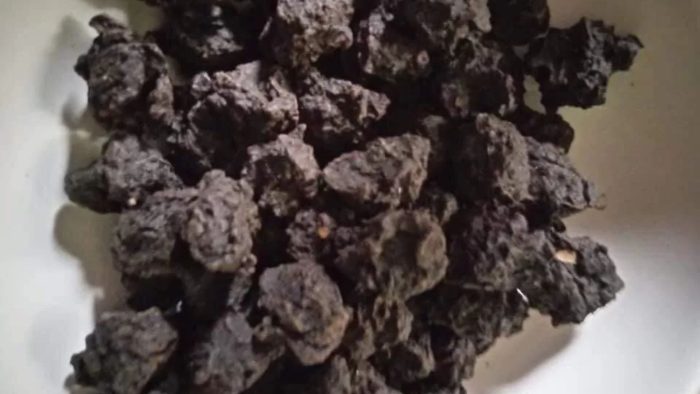
Then came the moment. She’d unwrap a small, dark parcel from its leaves, and this… aroma would just bloom, staining the air.
To my kid nose, it was a pure offense. A pungent wave of what I could only process as rot. Just, wrong.
I’d wrinkle my nose, clamp my hand over my face, and physically lean away from the pot. “What is that stink?” I’d whine. “You’re not putting that in the soup, are you?”
And she would just throw her head back and laugh. A deep, knowing laugh. She’d inhale the scent like it was the most expensive perfume in the world.
“That, my child,” she’d say, tapping the dark paste, “is the soul of the soup.”
To me, a stink. To her, soul.
It would take me 20 years to finally get what she meant. And it was about more than just the soup.
Last week, I unwrapped my own parcel of Ogiri in my own kitchen, miles and years away from hers. That same smell filled the air. But this time, I didn’t back away. I smiled.
Because I finally understood that the best, most essential things in life often come with a challenging first impression. Ogiri was teaching me how to embrace the “stinky” parts of my own life, the bits I used to run from.
Here’s what I’ve learned:
>> True value is often hidden beneath a challenging exterior.
That pungent smell is just a cover band for the main act: the deep, savory, can’t-put-your-finger-on-it flavor it gives the soup. Without that “stink,” the whole thing would be… fine. Just fine. Forgettable.
It reminds me of a colleague I once had. She was brutally direct, always the one to ask the hard questions in meetings.
Honestly, my stomach would tighten when she’d start talking.
I thought she was cold and difficult, and I avoided her. But then we got thrown together on a project that was falling apart. And I saw it: her bluntness wasn’t meanness; it was a fierce, almost desperate commitment to getting things right. Her feedback saved us from making a massive mistake. I had mistaken her passion for a personal attack.
We miss out on so much of life’s richness when we refuse to hold our nose and step closer.
>> Transformation requires engaging with the “mess,” not avoiding it.
You can’t make a great pot of soup by staring at the ingredients. You have to do the work. You have to chop and grind and stir. You have to willingly engage with the pungent, sticky paste to turn it into flavor.
A few years ago, I knew I was unhappy in my career. It was a dull, grey ache that sat behind my eyes, especially on Sunday nights.
But the thought of job hunting—the networking, the stomach-churning vulnerability of interviews—felt like too much ‘”mess.” So I did nothing. For a year. I told myself I just needed a vacation, but the avoidance just made the ache worse. It was only when I finally decided to wrestle with the mess, to face the truth of it all, that things started to change.
The magic doesn’t happen by wishing away the pungent parts; it happens by working with them.
>> What smells like “rot” to one person, smells like “home” to another.
My seven-year-old nose smelled “rot.” My grandmother’s nose smelled “home.” Tradition. The deep, funky taste of a life fully lived. We weren’t wrong, just…different.
For most of my life, I thought my sensitivity was a major flaw. A weakness. Something to be hidden, to be numbed out. I tried to build walls around it.
But I see now that this same sensitivity is what makes me a good friend. It’s what helps me write. It’s what connects me to the world. What felt like a vulnerable stink for so long is actually the essential aroma of my own personal home.
It’s not a bug; it’s the whole operating system.
Learning to love our own authentic, sometimes pungent, selves is the first step toward accepting others as they are.
Today, when that aroma fills my kitchen, I don’t run. I breathe it in. It’s a reminder from my grandmother, a whisper from my ancestors, to be patient. To look deeper. To embrace the whole, messy, beautiful, and sometimes stinky, truth of life.
The flavor is always worth the initial shock.
We all have parts of our lives we’d rather hide because they seem messy or “stinky.” But that’s usually where the good stuff is. So, I’ll ask you…
What is a “stinky” part of your life that you’ve learned to embrace?
I’d love to hear your story in the comments.
~
 Leave a Thoughtful Comment






Read 0 comments and reply