 Share on bsky
A Childhood Encounter that Never Left Me
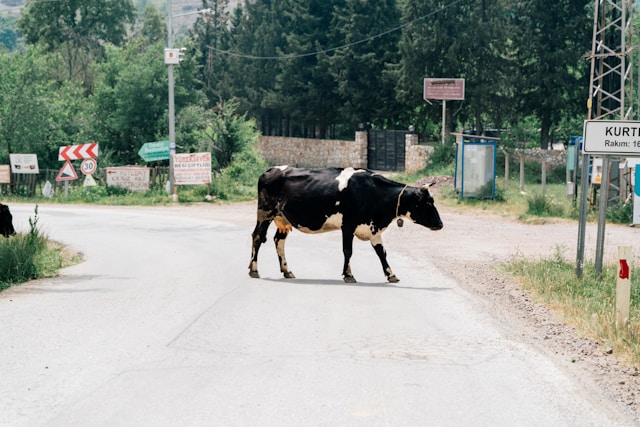
When I was six, my family sold our beloved pet cow in Hyderabad, India, before moving to New Delhi for my father’s new posting with the Ministry of Agriculture. To a child, the details were hazy—I only recall the heaviness in my parents’ eyes and the sense of something precious being taken away.
Three years later, when we returned to Hyderabad, an extraordinary moment unfolded.
One afternoon, a cow appeared outside our iron gate. She stood motionless, as if waiting. Drawn by curiosity, I went closer and saw her eyes: moist, mournful, full of a sadness I couldn’t quite explain but could unmistakably feel.
I called for my mother. She rushed out, took one look, and gasped, “It’s her—it’s our cow!” With trembling hands, she caressed the animal’s face as though reuniting with a lost child.
That moment etched itself in my mind: the recognition, the embrace, the unspoken bond between human and animal. Even as a boy, I knew it meant something profound—that animals remember, that they feel, that they love.
Years later, walking at dawn, I felt that same cow’s presence again—not in body, but in intuition. And in that quiet moment, I heard a message.
The Cow’s Message
“I am not just an animal who provides milk. I am part of the living fabric that sustains your soils, waters, and air. Like the whale who fertilizes the ocean’s plankton, I too enrich ecosystems. My gift is to heal, not to harm. But you have forgotten this.”
“You celebrate horses for therapy, and dogs and cats for companionship. Yet you overlook me. My calm gaze, my slow rhythm, my steady presence can be just as grounding. Ancient communities understood this. They honored me for my many gifts—for nourishment, for medicine, for the serenity of my presence. But today, I am confined, overfed grains that sicken me, and blamed for methane I was never meant to produce.”
“If only you let me live as I was meant to—grazing freely, cycling nutrients back into the soil—you would see the abundance I bring: richer fields, cleaner waters, calmer hearts. I am not your burden. I am your forgotten healer.”
What Science Hasn’t Asked Yet
Her imagined words raise a simple question: if horses and dogs can heal us, why not cows?
In rural communities, people will tell you that sitting quietly near a cow eases anxiety. Her presence is slow, steady, grounding. Ancient wisdom in India even suggested that living alongside cows fostered longevity and vitality.
Modern science hasn’t caught up. What might we learn if we studied this seriously?
>> Would interacting with a free, pasture-fed cow lower stress markers like cortisol in humans?
>> Do cows raised under industrial confinement show elevated stress hormones—and could that affect not just their health but ours?
>> Could regenerative grazing systems improve both ecological resilience and human well-being?
>> And, most haunting of all: how did my childhood cow know we had returned?
Science studies homing instincts in salmon and pigeons, but has barely asked the question for cows. That, too, is a frontier waiting to be explored.
Today, cows are often framed as culprits in the climate crisis. But methane is not their crime—it is the byproduct of how humans treat them. Confinement, unnatural diets, and industrial-scale exploitation distort their natural role.
A free, pasture-grazing cow is not a liability. She is an asset. She recycles nutrients, fosters biodiversity, and builds soil carbon. At the same time, her calm presence carries the potential for emotional healing, if only we allow her dignity.
The memory of my childhood cow—who found her way back to us after years of absence—is not just a personal story. It is a reminder of wisdom we once knew and then forgot: that prosperity comes not from exploitation, but from care; not from domination, but from partnership.
As we confront ecological collapse and human disconnection, perhaps the most radical step forward is also the simplest: to see the cow not as a problem to be managed, but as a partner to be respected.
If we listen closely, she is still waiting at the gate.
 Leave a Thoughtful Comment




Read 0 comments and reply