
 Share on bsky
*Editor’s Note: Elephant Journal articles represent the personal views of the authors, and can not possibly reflect Elephant Journal as a whole. Disagree with an Op-Ed or opinion? We’re happy to share your experience here.
~
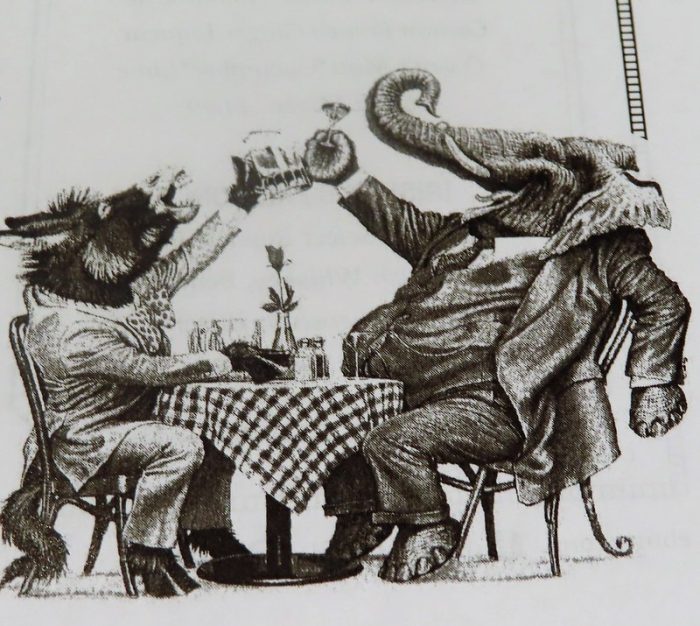
Beyond the Binary: a Call to Transcend the Left-Right Divide.
We live in a world defined by division.
Left vs. Right
Progressive vs. Conservative
Freedom vs. Responsibility
Change vs. Tradition
Chaos vs. Order
As a child, I grew up in a pretty a-political home.
There wasn’t much drum banging or hard rules about what to believe about life and the world.
This gave me tons of freedom to explore how I really saw things and felt about them. It also left me without a baseline foundation of belief and worldview from which to feel strongly about a large number of things.
This has been a double-edged sword for me.
It means I’m not quick to judge or draw conclusions about the rightness or wrongness of things. I’m less reactive and emotional about the conclusions I draw.
I can engage a polarized and highly complex topic for a long period of time without needing to decide who is right and who is wrong or who is good and who is bad. This is important. Crucial even, if we want to get such situations to any degree of authentic understanding.
And I have also noticed that I sometimes feel “on the outside looking in” on things that matter to others, or that I’m not really “part of the team.”
And in some cases, I miss important things that need attention and care because they just don’t register as alarm bells to me.
All that to say, I think we all have something unique and important to contribute to the larger discourse of what’s happening in the world—and what ought to happen.
When it comes to present day though, the modern political spectrum has reduced much of our public discourse to a narrow, binary tug-of-war, full of rhetoric, talking points, and ad hominem attacks that do nothing to actually bring us together and move issues forward.
And while this division can be exhausting, I wanted to shed light on a little understood and almost completely unexpressed truth about the necessity of polarity and what often shows up as conflict and antagonism:
These polarities exist for a reason. We need them.
This is hard for people who are locked…stuck…in the false narrative of opposition and right and wrong thinking.
So why do we need these binaries? Why do we need to learn to engage them in good faith?
Because each side sees and does something important. Vital even.
Yes, that’s right my liberal and progressive friends. The conservative perspective and values we see on the “other side” of the political spectrum have something important to contribute.
And vice versa.
I don’t want to talk around this issue or fling ineffective jabs at those I feel “just don’t get it.” I want to share and provide some insight that I think could actually help change things for the better.
Want to hear about it?
Good! Here it is.
The progressive lens reveals necessary truths. The conservative lens holds essential wisdom.
And yet, when either side becomes blind to its shadow or addicted to being “right,” both distort the truth they claim to protect and they squander the real gold in the wisdom they have to offer.
Let’s step back and ask a different kind of question.
Not “who’s right?” or “who’s wrong?” That won’t get us anywhere.
Instead, we need to ask:
What’s worth preserving and forwarding from each side of this polarity?
What’s worth critiquing, adjusting, and changing?
And how do we move forward, together, as something greater than the sum of our ideologies?
When we can start to engage these questions in good faith, we can come to the table knowing that we all bring blind spots and biases.
We can vulnerably and courageously hold the fact that for us to truly create a better world, we all have to heal some things and own some accountability. And it will not be easy or comfortable for us to do.
This orientation and approach sets us up to be more constructive and supportive to human connection and our shared values. It allows humanity to shine through in the end.
Now, let’s dig a bit more deeply into the value and liability in each of these familiar but poorly expressed world views.
What the Progressive Lens Gets Right
At its best, the progressive worldview is a stand for rightful change. Healthy and appropriate evolution of the past and the status quo.
Obvious, right? I mean, it’s in the name!
It believes in humanity’s potential to grow, change, and become more inclusive, compassionate, and free. At least that’s what’s on the proverbial progressive boiler plate. We’ll get to the ever-increasing hypocrisy of the left around the present day movement of progressivism later.
But at its best it values:
>> Social Justice: an unwavering attention to marginalized voices and systemic inequities.
>> Empathy and Compassion: a belief that people matter and suffering isn’t acceptable just because it’s normalized.
>> Change and Adaptability: a trust in our ability to reimagine systems and structures to better serve more people.
>> Individual Identity and Expression: a deep care for personal autonomy, self-expression, and the right to be oneself without shame.
Progressives often act as the moral and emotional thermostats of a culture, feeling what’s not working and speaking up or agitating for a better way and a better world. They remind us that just because something has been doesn’t mean it should be.
But when taken to extremes, the progressive lens loses the ground it needs to stand on.
The Shadow of Progressivism includes:
>> Idealism untethered from reality.
>> Reactionary politics based on emotion rather than wisdom.
>> Default moral superiority regardless of the topic being discussed.
>> Prejudice and racial discrimination, cancel culture, and purity tests that punish and exile in the very way the original civil rights movement aimed to address.
>> A distrust of tradition, structure, and the wisdom of the past.
In trying to “liberate” everyone, progressivism sometimes forgets that a just and free society must include differing views, personal liberty, and acceptance of how and where we see things differently.
What the Conservative Lens Gets Right
At its best, the conservative worldview is a stand for what’s sacred.
It believes that hard-won wisdom, structure, and tradition are worth protecting—and that without them, society crumbles into chaos.
It values:
>> Order and Stability: the belief that functioning systems require consistency, structure, and shared values.
>> Personal Responsibility: a respect for discipline, accountability, and earned growth.
>> Cultural Cohesion: a sense that unity requires some shared identity, rituals, and/or principles.
>> Pragmatism and Realism: a grounded awareness that not all change is good and not all intentions lead to positive outcomes.
Conservatives often act as the moral and cultural anchors of a society—holding the line, protecting what works, and guarding against impulsive and often destructive shifts.
But when taken too far, the conservative lens also distorts.
The Shadow of Conservatism includes:
>> Rigidity and resistance to needed change.
>> Nostalgia disguised as wisdom.
>> Suppression of difference or dissent.
>> A tendency to preserve unjust hierarchies under the guise of “tradition” and what is “right.”
In trying to preserve order, conservatism can forget that some orders were built on domination, and not all traditions deserve to be passed down.
When Ideology Becomes Identity
The deeper problem isn’t just the ideas. It’s the way we identify with them. Mostly without knowing that we’re doing that.
We’ve made ideologies into who we are.
We’ve turned political preferences into moral litmus tests.
We judge people not by the content of their character, but by whether they use the “right” hashtags or vote for the “right” tribe.
We’ve forgotten that human beings are not algorithms. And the world is too complex to fit on a single axis.
Before I talk about how we might start to do this whole dance of political and social discourse better, I wanted to speak to a piece I feel is also mostly missed.
What’s that?
The underlying and very human reasons we can get so lost and angry about how and where we disagree.
The Way Forward: Integrating Wisdom from Both Sides
The future isn’t left or right.
It’s forward.
And forward requires integration.
Just think of a row boat wanting to go straight. It has no hope of getting anywhere if only one side is paddling, and it certainly isn’t going anywhere if we’re just hitting each other with our oars.
We have to come back to a place where we are asking honestly: Where does this value or idea belong? What value does this idea or act serve, and how can we maximize that while addressing the potential risks or limitations?
We need:
>> The progressive vision to dream of what could be, and the conservative discipline to build it sustainably.
>> The progressive compassion to care for the vulnerable, and the conservative clarity to enforce healthy boundaries.
>> The progressive openness to diversity and transformation, and the conservative loyalty to what is tested and true.
This isn’t compromise.
It’s collaboration.
Because the most dangerous people aren’t on the left or the right.
They’re the ones who’ve stopped listening, stopped learning, and stopped believing that anyone outside their tribe could possibly be worth understanding.
And there’s a simple practice to start bridging this gap in yourself: self-inquiry. So, ask yourself:
>> Where do I tend to align politically and what do I love about that worldview?
>> What has my “side” gotten wrong and where has it gone too far?
>> Where might I be blind to wisdom that lives across the aisle?
>> What would it look like to lead from the values of openness, curiosity, and care, instead of tribalism and ideology?
And then—listen.
Not to win.
Not to prove.
But to learn.
To grow.
And in turn, for us all to become more connected and whole.
We were never meant to choose between freedom and responsibility, between compassion and structure, between tradition and change.
We were meant to dance with them.
To honor the tension.
To grow into a maturity that holds both truths at once.
Because the truth isn’t at the poles—it’s in the nature of the relationships between them.
And maybe, just maybe, if we start there, we can begin to build something worthy of everyone.
~
 Leave a Thoughtful Comment





Read 0 comments and reply