

 Share on bsky
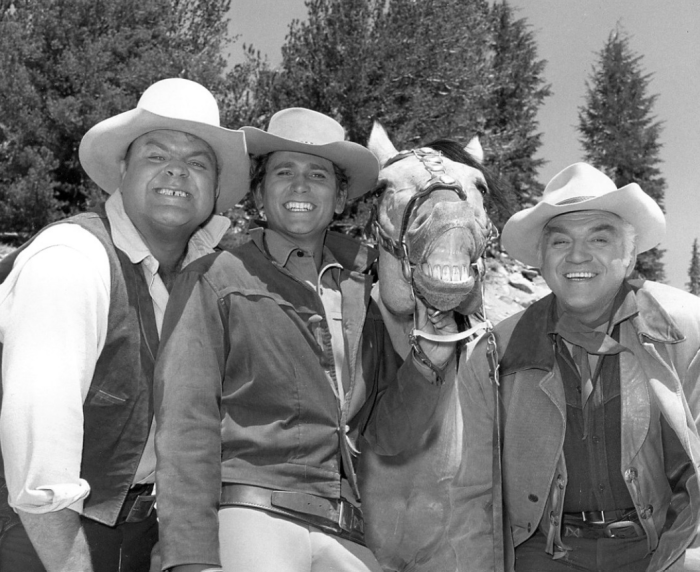
Whenever I’ve felt overwhelmed watching the news and can’t find anything inspiring on Netflix, I’ve been reduced to watching reruns of “Bonanza”—yes, it’s gotten that bad!
“Bonanza” was a popular show. It ran from 1959 to 1973 with over 440 episodes, becoming the second-longest-running TV show. And wouldn’t you know it, the themes and storylines cover all the issues we are facing today—racism, misogyny, cruelty, corruption, cheating, lying, and there was even an episode about arguments over the school curriculum and what kids should learn about history.
What really stands out in this show are the men.
Set aside the noble and wise fatherly figure, Ben Cartwright, and his three well-meaning sons, Adam, Hoss, and Little Joe; most of the men portrayed are a bunch of insecure, misogynistic, emotionally immature, trigger-happy, and always-looking-for-a-fight kind of guys.
Yep, even “Bonanza” had its MAGA Men.
One of my pet peeves is that the great movies such as “To Kill a Mockingbird,” “Guess Who’s Coming to Dinner,” “It’s a Wonderful Life,” or the great Ken Burns documentaries that tell the truth of our history, or the classic novels of Eliot and Dickens that teach us so much about human nature, are more than likely never watched or read by MAGA folk. They never get to experience these bodies of work. It’s a cliché to say it and it may not fit every MAGA individual, but typically, they’re just not interested in them. And so, the works that expose and teach us about injustice or immorality are, in a sense, preaching to the choir.
It’s disheartening to think that millions of people never get to see or read these works. They simply don’t know what they’re missing.
But here’s the thing: “Bonanza” is no high-brow show. It was watched by people from every walk of life. My own working-class dad never missed an episode. Why did a lot of men who loved watching cowboy shows never grow up emotionally? Why did nothing change for them?
It begs the question(s):
Do books, movies, and documentaries impact people?
Do they have the power to change a person?
Why are we seeing so much blatant, shameless cruelty and lack of morals today?
One of the biggest challenges as an English college instructor was how to get young twenty-year-old men hiding under their baseball caps to read a Jane Austen novel.
Austen’s novel, Persuasion, was on the syllabus. They had no choice. On the first day of class, I could feel their rumblings of resistance. I needed to come up with my own form of persuasion. I ended up telling them that this novel will teach them how to “get the girl”—that by the end of this novel, they will know how to treat and speak to women. That focus changed everything. We ended up having some great discussions about dating and flirting.
I have no proof that those young men were impacted by Ms. Austen’s novel. Who knows what it is that makes a person kind, truthful, misogynistic, romantic, or cruel? In fact, there is clear evidence that literature and movies do not make a person moral. Let’s not forget that the Nazis delighted in the works of Sophocles, Shakespeare, and Herman Hesse.
For all the moral superiority you may accuse me of in writing this post, let it be known that there have been times in my life when I’ve lied, cheated, and been unkind.
I’ve been all of that.
And at the age of 71, I can still be fiercely judgmental of others. I am in no way a model of morality. And this is what gives me hope, because it’s taken me decades to have the courage to own my faults and try to be a better person. But change does eventually happen.
I still have faith in a good movie, book, or TV show. They can leave me feeling all warm and fuzzy about humankind. Could it be that “Bonanza” allowed those men to escape from their drudgerous and deadening lives for just one hour a day? We’ll never know the truth of what that one hour of cowboy TV did for their souls.
When it’s all said and done, I believe that all of us are good and kind at our core. Goodness and decency are who we really are, and unfortunately, life has a way of beating that goodness out of us. There have been many layers that have gone into making us who we are.
Martin Luther King Jr. said it well, “The arc of the moral universe is long, but it bends toward justice.”
Let’s hold on to the idea that our collective journey towards fairness and goodness is inevitable.
~
 Read 1 Comment and Reply






Read 1 comment and reply