
 Share on bsky
Sound for Strength
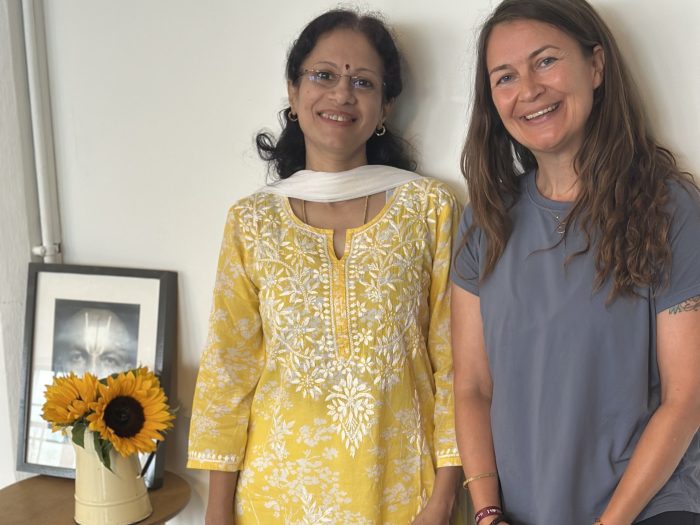
I first studied with Nitya Mohan in Munich in 2018.
I had been practising Yoga for nearly two decades, considered myself reasonably serious about it, and then spent three days having my assumptions dismantled, one by one.
What struck me most was the moment she asked us to use our voices.
Not to perform, not to be musical, just to sound. The resistance I felt told me everything I needed to know about how estranged I had become from something entirely natural. (And this is coming from someone who has been a singer and musician her whole life.)
And yet I keep coming back: to a monastery in Wicklow on the Irish coast in 2019. Manchester in July 2024. Osnabrück, where I brought her to teach last Autumn. A 10-day retreat in India in January 2025 with her parents, A. G. Mohan and Indra Mohan. Each time, something shifts, and another lost part of my identity is returned to me.
Nitya was born in 1973, the same year as me. It’s astonishing watching someone your own age embody so completely what the Yoga Sutras of Patanjali actually describe—as a lived practice, not a subject of study.
She’s the director of Svastha Yoga and Ayurveda teacher training programs in Singapore and has been teaching for over 25 years. She was trained from a young age in Yoga, Sanskrit, Vedic chanting, and classical music. Her passion lies in combining traditional Yoga practices with music, mantras and Sanskrit in her teaching.
She has inherited her father’s vast scholarly knowledge and his sharp, warm wit, and her mother’s wisdom, emotional depth, and gift for storytelling. The combination is rare, and it is what makes her not merely a very good teacher but an exceptional one.
I keep returning also because I believe we need this right now.
Those of us who want to be of benefit to this ailing world need our voices, and we need our resilience—the kind that is rooted deeply enough to remain steady and compassionate when everything around us is not.
The tools Nitya teaches—mantra, pranayama, bhavana—are not escapes from the world, but, on the contrary, what equips us to stay present in it.
This September I am bringing her to Paris, essentially as a volunteer alongside running my branding agency, because I keep thinking about who else might have that moment of recognition I had in Munich eight years ago, and what it might open up for them.
Below I’m sharing an interview I first conducted with Nitya for the German Yoga Journal in 2020, updated now for the workshops she will be teaching across Europe in Autumn of 2026.
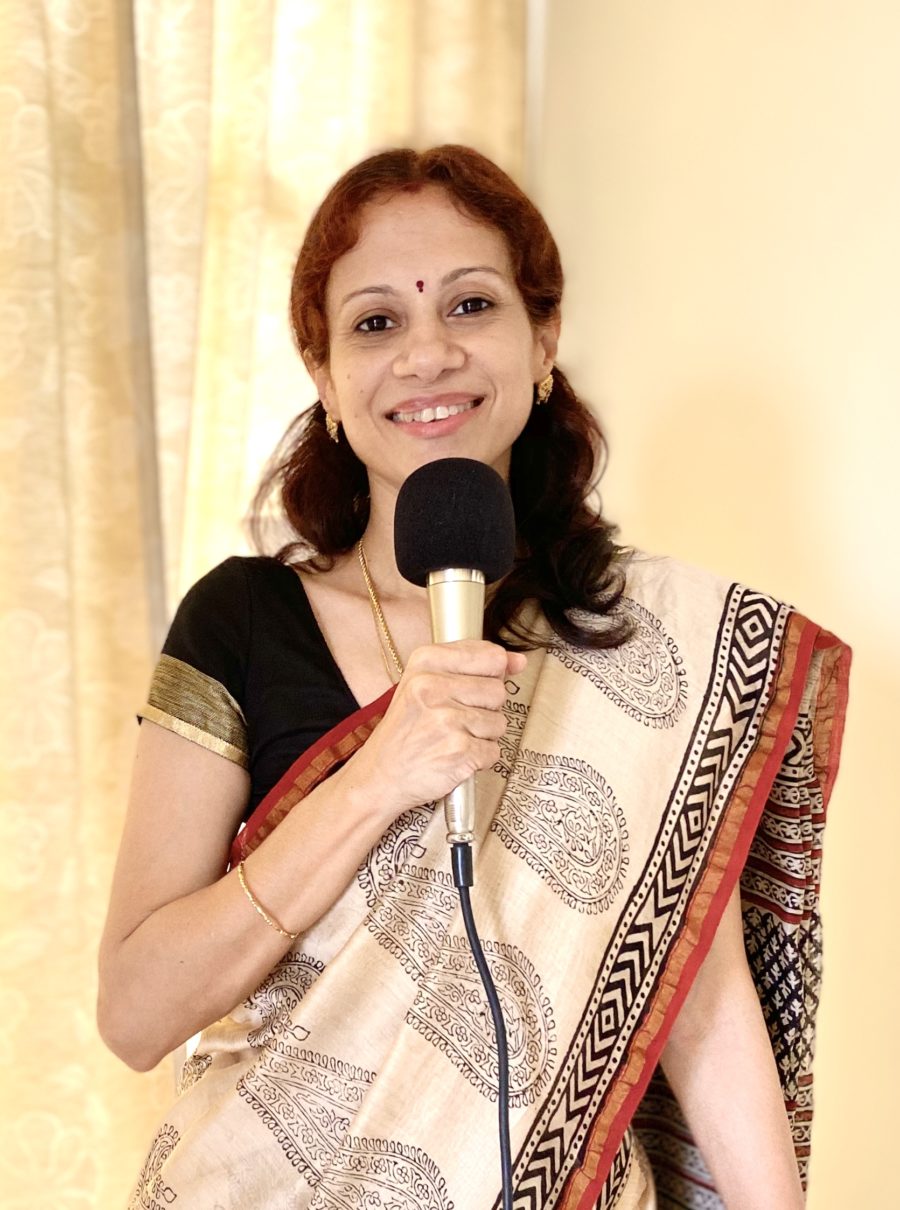
You grew up in a family that lives and, literally, breathes yoga; your parents were direct students of Krishnamacharya’s for a long time. Having his tradition integrated into your daily life from a very early age, did you ever question it or rebel against it?
When something is a part of your daily and integrates into what you do, it becomes just that—a way of living. My father met Krishnamacharya before I was born, and my mother has been walking beside him on that journey from day one. To be honest, when I grew up as a child with Yoga, Vedic chanting, Sanskrit, and music, I did not realize that it was very different from what other children were doing—simply because this was the “normal” in our home. When I started to teach Yoga, it was not a conscious choice as a career path. Well, Yoga was not even so popular or well-regarded back then—I just did it as it was what I had grown up with. Now looking back, I am glad I did.
What would a typical day look like, which sound, singing or chanting rituals were a part of it when you were young? Who passed them on to you—your parents, or, as you mentioned once, your grandmother?
My parents for the Yoga, Sanskrit, and chanting parts and my grandmother for the music. Yoga, chanting and music were integrated very naturally into many daily life activities and not done exclusively as standalone practices. For example, chanting would form a part of a morning Asana practice as well as daily rituals that were usually done later in the day. My grandmother who lived with us, taught me to sing at various times during the day—as she would wash and prepare vegetables, as she was cooking or as she rested in the afternoon.

You now teach the connection of Yoga and sound in workshops and Yoga teacher trainings in the Svastha tradition coined by your parents around the world. What makes your family’s approach different to other strands of Hatha yoga?
When my father studied and taught Yoga for decades, he did not have a label or brand name for the work he did. When we were growing up, my brother Ganesh and I would be a little perplexed when someone asked—what kind of Yoga? Because there was no need for that—it was Yoga as taught by Patanjali in the sutras. Some years ago, when my parents had to pick a name in early 2000, they chose Svastha—not with the intention of creating another label or style but because SVASTHA is the word used to describe a perfect state of physical, mental, and physiological health and balance. Today, we tell students it is not Svastha Yoga as in, another style of Yoga, but rather it is Yoga for Svastha—all the practices that we do under the umbrella of Yoga, should lead us to that state of Svastha or health and balance, as envisioned in the ancient texts.
Here in Germany, and in the West in general, it’s safe to say that chanting during asana or pranayama practice is not common at all. In fact, people even seem to be rather put off or scared by it. Why do you think that is—and what are the benefits of using sound as part of your practice?
Perhaps this is partially due to the fact that sometimes chanting in yoga is mixed up with religion—as the chants that are used are perceived as part of a different culture and hence many students do not feel a connection to them. This is understandable. However, the way I believe sound work should be started is from the perspective of using sound as another tool. Just as my body, breath, and mind are tools that I work with in my Yoga practices to lead me to better health, sound is an extremely useful tool that can help us work on and integrate into all aspects of health and well-being.
For example, understanding my voice, learning to simply use my voice as a tool, understanding how my mind relates to sound, why my thoughts are all inner sounds, using neutral simple vowel sounds and then simple words that I can form a connection with, learning to steady my mind with sound, connecting to different emotions with different tones—these are essential skills for well-being.
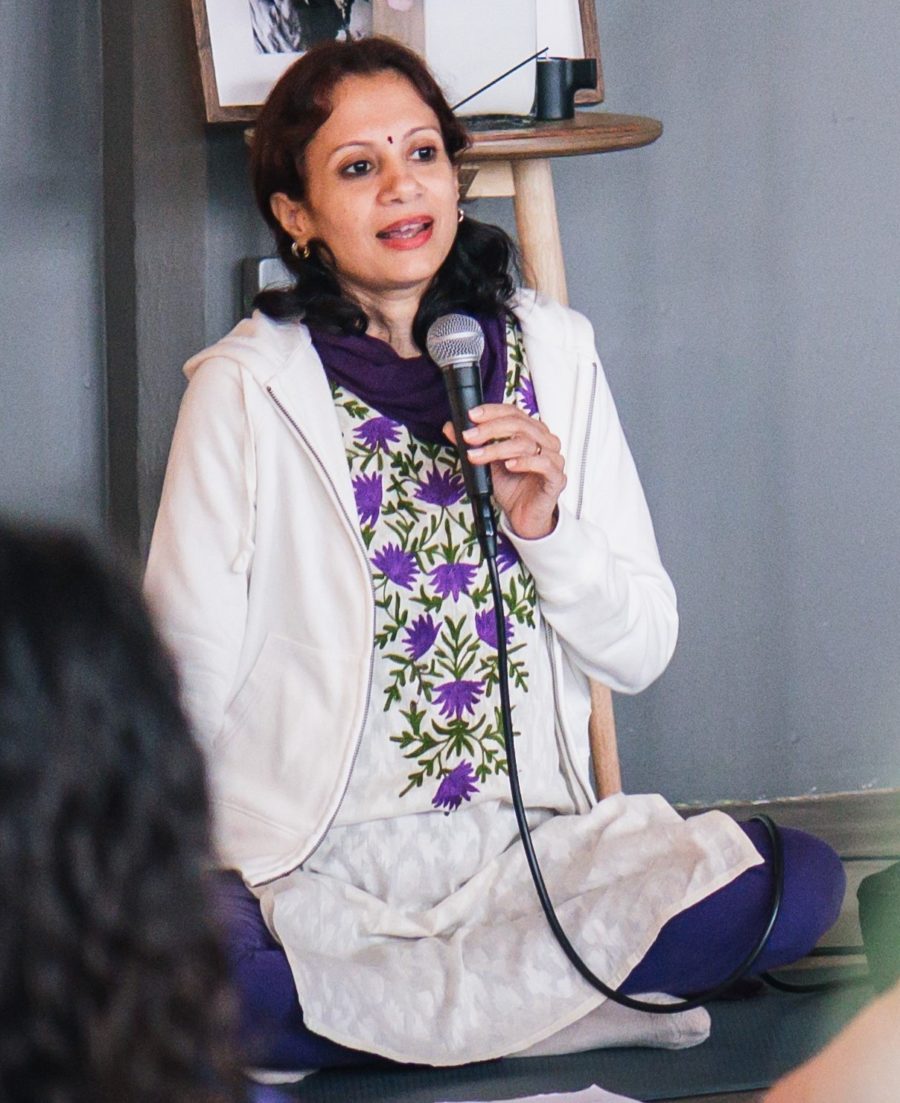
After all sound and music are truly universal—they need not and should not be limited by any barriers of culture or beliefs. All ancient civilizations from several thousand years ago, had some form of sound integrated in their daily lives —as singing, humming or simply making pleasant sounds. It was universal—as in everyone did it—you did not have to be a musician or performer in the olden days to sing. I think even if you go back a few generations in your own family, you will see this was true. Sound was a part of daily life, we have somehow lost that connection now and we seem to bind ourselves with so many notions—I can’t sing, I cannot hold a tune, my voice is bad etc.
Our nervous system does not judge us—if I sing and enjoy the singing, my nervous system will automatically release those endomorphins and oxytocins—however badly I sing or how much ever out of tune I am. This has been proven time and again by multiple scientific experiments. If I can learn to use my voice, it is a huge support in all my healthful practices. This is something I would really love for everyone to start exploring—to break their inner notions of self-judgement and learn to use sound as a tool for health and wellbeing.
Can you give our readers a concrete example of an easy beginner’s thing to practice that makes them feel the effect of using their voice for themselves?
For a start, begin with simple practices that can help you relate to your own voice better. Start working with simple vowel sounds and do some vocal toning. Learning to link your breath with your voice is a wonderful starting point as well, because sound can help lengthen the breath which is turn will help you produce a deeper sustained sound which will then impact your entire system positively. When you listen to a piece of music, allow yourself to connect to it a little deeper with your breath, observe the effects of different tonalities and scales on your breath and mind. Your voice is a very deep part of your identity—make that connection pleasant to start with.
Making yourself heard and raising your voice, in the unique way that only you can, is an essential part of our individual identity as human beings. Do you feel Yoga can be political, or even revolutionary, or would you say the practice of Yoga, with its foremost goal of inner peace, indeed makes you withdraw from the world and its human, all-too-human goings on? Does “real” Yoga make one a radical individualist—or can it make us more mindful of our human connection to all other life on the planet? Can I raise my voice against deplorable currents within our society and the spiritual community, or does that make me a “bad” Yoga practitioner?
Traditional Yoga based on the Yogasutras of Patanjali is completely logical and scientific. It is the same in most ancient texts. By scientific what I mean is that they encourage analysis, questioning, and a deeper understanding that is rooted in solid, unshakeable logic and truth. And in those very texts, they also speak of the qualities that we should aspire for as yogis—maitri, karuna— friendliness, understanding, compassion for fellow human beings, gratitude, empathy, love—all of these should make us more willing to change ourselves for the better. True progress in Yoga is about how evolved I am in terms of these qualities and how I reflect those in my habits, choices, disciplines and daily life.
Yoga should make us more mindful of our choices and responsible for our actions, thereby creating better connections with those around us. Though the final goal is to simply remain as “awareness” or “concsiousness” as the true “I”–this “I” cannot be found without going through that path of Maitri and Karuna. A monk was not expected traditionally to follow societal rules but we must remember that a monk lived in total complete isolation from society. He did not follow the common rules because he was not connected to society in anyway, he lived in the forest completely alone. When we live as individuals in a society, this is not a choice—the practices of yoga must make us more sensitive to others’ needs, more compassionate, grateful, and mindful and not the other way around.
What are the sources that are your personal favourite within the ancient texts—and can you point interested readers who want to look into the connection of Yoga and sound to concrete places? Or was it all oral tradition, passed on by Krishnamacharya?
There are innumerable sources for any area of study in the Vedic wisdom, the biggest strength is the vastness of literature that is available—sometimes a source of confusion as well. The Yogasutras themselves mention the use of Mantras in several places in Ch 2, sutra 1—under Svadhyaya. It is also mentioned in the concept of Isvara Pranidhana in the Ch 1 sutra 27 and 28. There are other texts on music like the Natya Shastra which connect music and the mind/emotions. There is also literature in other music texts like the Sangita Ratnakaram, Naradiya Siksha, etc. which present these connections between tones, pitches, emotions, and musical scales. My father actually studied some of these texts and connections in great depth after the demise of Krishnamacharya with other experts in those fields. What I teach is an amalgamation of all of that along with my own exploration of practices in classical music.
Do you contribute your own ideas and practices to the further development of that nexus—are you a force of renewal or is your approach purely traditional?
What I teach is rooted in the classical texts but is also built upon and developed further from there—which is the way reliable teachings should probably be—sourced from authentic knowledge, developed and validated by further research, practice, and explorations.
I source the fundamental understanding and explanations of the concepts from the ancient texts. The why’s are all based on the logic and astounding clarity that can be found in those texts on the connections between our body, mind, sound, emotions, pitches, scales, mantras, etc. The how’s I draw from those texts and also adapt and develop practices that are suitable for current times based on those foundations. There are several inter-connections between the areas of music, mantras, and yoga—which I love to discover, explore, and teach because they make it so easy. As a musician, you know this too—does someone really have to force you to enjoy music? Often we say that Yoga should also be like that—the practices of asana, pranayama, and meditation should be self-rewarding, then it automatically remains sustainable; this becomes super easy when we integrate music and sound work into Yoga!
Those of us who grew up in environments alien or even hostile to the idea of Yoga and spiritual development in general—do we have a chance at truly progressing on the path, or will our samskaras be too strong/deep if we only found it as (young) adults?
All of us always have a chance at Yoga. This is absolutely true. That is the fundamental premise—that samskaras can be changed, however strong or deep rooted they are. If this is not true, then no kind of development is possible neither is the final state of kaivalyam or nirvana attainable. Anyone and everyone can do it. Yes—a stronger samskara will naturally take more effort to replace, perhaps take a little longer as well, but it is possible for anyone irrespective of culture, upbringing, or past habits to make a change in the positive direction. The results we reap will be proportional to our efforts.
Thank you for this conversation, Nitya!
If you enjoyed this conversation, I’m looking forward to attending my fifth workshop on Sound for Well-Being and Mantra for Resilience with Nitya in Paris this fall. Want more info and attend? Check out my Elephant Journal profile page for the details.
~
 Leave a Thoughtful Comment





Read 0 comments and reply