Want to stay in touch with elephant? Get 10 free articles a week: subscribe free to our Best of the Week newsletter
or get our popular Daily Wake Up Call. Together, we can make mindful independent reader-created media powerful!
Submit a story.

Please "like" our facebook pages: Main Page
Yoga / Love / Food / Wellness / Spirituality / Family / Culture / Green / Society / Work
Enjoy the top 10 blogs of the week free in our e-newsletter.

Why Your Next Steak Might Kill You. ~ Monica Johnson


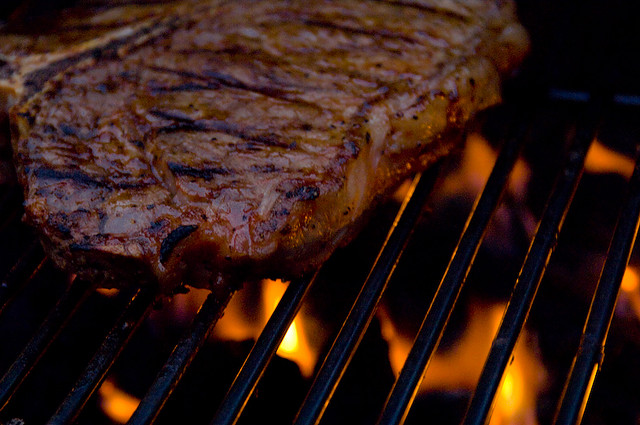
T-Bone Steak 1

Dangerous pathogens, such as E. coli, are generally present in beef.

In fact, ground beef is so synonymous with harmful bacteria that there are strict safety standards that call for inspections of the meat. This is a good thing.

Primal cuts of meat, such as steak or roasts, are not usually tested. This is not a good thing. This means that more dangerous bacteria-infected meat makes it to the market for the consumer to purchase.

But wait, there’s more!

A year-long investigation by the Kansas City Star, called Beef’s Raw Edges, revealed that a common practice in meat processing plants is to mechanically tenderize cuts of meat that may be tough. It may also be called bladed or needled meat.

If the meat is tenderized on a conveyor belt and one steak contains dangerous pathogens, the needles or blades may now contain that pathogen and can pass it onto the next piece of meat.

A majority of this meat is sold to family-style restaurants, hotels and group homes.

So, the next time your waitress asks how you want your burger or steak cooked, consider saying, “Well-done!”


Monica Johnson head-shotMonica Johnson is proud to call New York City her home, though she equally loves Mount Desert Island, Maine. In an ideal world, she would split her time between the two. She also loves hiking and puppies.


Like elephant food on Facebook


Assistant Ed: Amy Cushing

Ed: Bryonie Wise

 

photo by: TheBusyBrain

Incorrect source, offensive, or found a typo? Or do you want to write for Elephant?

Monica Johnson grew up in the Midwest where her ancestors farmed the land. She recently graduated from The New School for Public Engagement in NYC with a Bachelor of Arts focusing on food studies. In 2012, she apprenticed at Eagle Street Rooftop Farm in Greenpoint, Brooklyn. As the upcoming farming season is starting, she is looking forward to working in urban agriculture and writing about food.

278 views

1,200,000 readers this month/2,100,000 pages read ~ Google Analytics (real #s, not hype).


Support our Writers, Create Mindful Independent Media How much did you like this post?
That's great $1.00     Love it $2.00     Life changing $3.00     or choose your support...   $

If you liked this, you might like these:


4 Responses to “Why Your Next Steak Might Kill You. ~ Monica Johnson”

  1. I do trust all the concepts you have offered to your post. They’re really convincing and can certainly work. Nonetheless, the posts are too brief for newbies. Could you please extend them a bit from next time? Thank you for the post.

  2. monicamjohnson says:

    Hi there-
    Thanks for your comment. If you are interested in learning more, I highly recommend my two sources: The USDA website (http://www.fsis.usda.gov/Fact_Sheets/Meat_Preparation_Fact_Sheets/index.asp) and the article by The Kansas City Star (there is a link in my article to it).
    Hope that gives you the details you are looking for!
    Monica

  3. Ron Raymond says:

    They should really make it a point to thoroughly test steaks. It's not fair to people like me who like theirs rare or medium-rare.

  4. Miley Storm says:

    Yep. People have preferences, too. It's up to the restaurant to maintain cooking beef while considering the hygiene of the preparation. I personally like preparing them on my own. Especially while boating.

Leave a Reply


19 queries in 0.380 seconds.