
Ten Things that are Bad for Us that can be Good for You if Practiced Mindfully.

Ten Things that are Bad for Us that can be Good for You if Practiced Mindfully.
Inspired by Mindful Vice Training!
Marijuana.
It can cloud the mind, making you paranoid…or it can relax and lighten. The difference?
Mindfulness. Be present when you smoke, and like wasabi it’ll light you up without burning you down.
Sex:
it can be an addiction, a goings-through-the-motions, an act of conquering or speed…or it can be poetry, surfing sweat, the tides of life, honest and open communication (speaking in tongues, and sighing). The difference?
Mindfulness: eye contact’s a good start. Don’t fake anything: instead, tell one another what turns you on, treat one another with respect and intimate exactitude, take your time.
Alcohol:
it can be too much, too often, with pain, with driving, with anger, with fights, with sadness, costing too much money, sucking love. Or it can be appreciating, mixed or straight, with sacred head and shoulders, with a smile, with style, with humor and passion. The difference?
Mindfulness. Read here for some more in-depth perspective via Ted Rose.
Technology:
it can help us work and achieve and build and sort and help and extend and connect…or it can disconnect, suck away our power and passion and dreams into a lost world of stale cocoon. The difference?
Mindfulness. Take breaks. Be present. Do one thing at a time. Remember your mission or vision, instead of getting lost in the technology loop.
Food:
It can be delicious and nourishing and help us get done what we want to get done and do what we want to do and it can delight and entice and fill up and…oh, who doesn’t love food. Or it can be too much, too fast, too cheap, to processed, but sweet and salty and greasy in a way that makes us want it without ever quite getting full. It can fill us and keep filling us until we’re walking about lugging an extra hundred pounds, losing years on our life. It can give us diabetes at the age of 18, say, it can provide an eternal itch of never-satiated hunger. The difference?

Mindfulness. Eat real food: less processed, closer to its original form. Less packaging, plastic, preservatives, chemicals, less patents and laboratories and politics, more healthy, cancer-free. Go with Michael Pollan’s three simple rules. If you’ve seen it advertised, avoid it. If your great grandma ate it, go for it. Eat sitting down. Don’t eat while doing something else, like…driving. Or walking. If you eat too much, go easy on yourself…and stop.
Transportation:
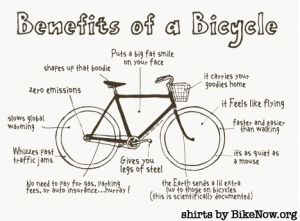
It can be free, with no parking hassles, and it can be free exercise, with fresh air. Or it can be commuting through hours of traffic, paying too much for gas that comes from Canadian tar sands or helping to fund war and strife. It can be elegant, or it can be cheap and dirty. The difference?
Mindfulness. If you drive, drive something that gets reasonable mpg. Old cars and trucks can be an elegant joy to own and drive—and more eco, in that you’re not adding to the buy-sell supply-demand cycle. New cars, if hybrid or say electric, can be clean, efficient, and your purchase helps revolutionize the business of the automobile. Or bicycle, or walk, or bus—and you’ll enjoy health, community, sunshine, valet parking, no insurance or maintenance charges.
News & Entertainment:
It can be fun, bring us together with our friends, it can be art, it can be connection, it can be calming and enlightening and change our world. Or, it can blur our thoughts, make us into smiling masks, cows and sheep, it can be the opiate of the masses, it can harden with hate and rhetoric and fill the space of the mind and airwaves that otherwise would be reserved for ideas, visions, dreams and flashes of insight. The difference?
Mindfulness. Put away the lit up screens, once in awhile. Don’t walk while texting. Don’t drive while phoning. Do one thing at a time, and do it well. Only go to movies that one really wants to see: remember our hours may seem limitless, but we’re all given just so many grains of sand in our hourglass.
Judgment.
It’s no secret that New Agey types love to (ironically) hate on others for “judging.” What they mean, or what we mean, to criticize is pre-judging. You know, prejudice. For judging can be a good thing, or a bad thing. In Buddhism, judging is viewed as essential, a potential positive. It’s prajna, or discernment, the sword of wisdom that pierces confusion or neurosis simply.
I judged just yesterday when I chose to eat (and share) an organic apple over the processed potato thing and dyed-red pear and hot dog smothered in…something in a white flour preservatived bun that looked as if it’d gone to the moon and back—in 1968. Of course, we also judge that we need two to-go coffees and a plastic lid and to waste dozens of paper napkins when we go out. Judging is a tool that can create a more eco-responsible world, a kinder world, a healthier world—or a speedier, cheaper, more selfish world. The difference?
Mindfulness. If our judging is motivated by reality, instead of by preconceptions (a la climate change deniers, say, who put partisanship over science), we see reality instead of our own views reflected in our experience. As Sherlock Holmes said, it’s our job to see whatever is, no matter how unlikely, instead of creating a supposition and finding the facts to suit.“I never guess. It is a shocking habit,—destructive to the logical faculty.” ~ Sherlock Holmes
“It is a capital mistake to theorize before one has data. Insensibly one begins to twist facts to suit theories, instead of theories to suit facts.” ~ Sherlock Holmes
“Eliminate all other factors, and the one which remains must be the truth.” ~ Sherlock Holmes
“When you have eliminated all which is impossible, then whatever remains, however improbable, must be the truth.” ~ Sherlock Holmes

Losing our Temper:
We all lose our mind from time to time (me: daily).
For me, in my business life, my anger is usually wisdom: it helps me break free of bullshit—but only if I don’t take it out on others. In my personal life, it’s harder—we never want to hurt those we love. In Buddhism, it’s the fourth karma: ie, it’s playing basketball on the moon blindfolded, ie, only for those who can handle some advanced, difficult stuff. That’s not you or I, most likely. So how do we transmute our anger? What’s the difference between wisdom and neurosis, here?
Mindfulness: the trick is not to expect us to ever hold our mind 100% of the time. Peace is not a state of mind; it’s more like surfing. Instead, as the Buddha advised, treat one’s mind like a guitar, tuned not too tight, not to loose. Lose your mind, or temper? Just come back to the present, without blame. Leave the room if you have to. As Buddhism advises, if you’re angry, turn your self into a piece of wood—ie, do not act out your anger. Just leave. Anger is frustration, and fear, usually. It’s also something we regret 2.5 minutes later…so just go quiet or get away for 2.6 minutes.

Mindfulness Itself:
Spirituality and religion can help us to be kind, and patient, to learn, to connect with community—or they can become fixed, dividing, materialistic dogma. Mindfulness itself can be meditation, at its root—training us to connect with our own basically good human nature—or it can be a spiritual shawl, self-serious religious veil we draw around us to look and pretend and busy ourselves with the act of “being spiritual.” The difference?
Mindfulness, at its root, is meditation: in Buddhism, it’s called a self-burning flame. Or a self-cutting sword. So remember: we’re doing all this not to look or act serious and cool. But to lighten up, ground down, stand tall and smile sadly—acknowledging the sadness and weight of the suffering and confusion of this world, and at the same time appreciating the elegance, joy, compassion and fun that is our human birthright, if only we choose to claim it.
So meditate. Don’t do it as a religious act, but as a practical one—like brushing your teeth, you can do it twice a day, just after we wake, and when we prepare to go to bed.
~
What’d I miss?
What else? Suggest in comments, or write your own, and I’ll add it in with credit.

Incorrect source, offensive, or found a typo? Or do you want to write for Elephant?


Hi Waylon, you touched on a few chords there for me! Yes, mindfulness – but also mindfulness about our own patterns. I've become aware over the years that it's not simply a matter of approaching a substance/issue/subject with a sense of the sacred but that our own self-awareness about when and why we 'use' it (even if 'it' is entertainment) is equally important. I've seen some smoke weed several times a day and appear to thrive, while others do the complete opposite despite having a deep reverance for it. In along with mindfulness there is that little thing which I could call wiring – others might call it genetics.
But I've also seen the reverse of this – things that would normally be considered 'good' for us ending up being 'bad' for us. Those who overdo the meditation, spirituality, yoga – hiding in a practice to the detriment of other areas of their lives.
Balance has a lot to do with it.
Really interesting territory!
There's another great blog! Then great things that can turn to poison if used or abused improperly. Wanna write it?
I don't smoke pot—I ascribe to this http://www.elephantjournal.com/2010/06/why-not-to… —but I certainly don't begrudge those who do if they do so mindfully, and it's fine for them and helps them in some way.
I think the undercurrent here is intention. If we do these things (or anything) to be present, to engage, to "pick strawberries," then they can benefit us and the people with us. If we are doing them to escape and avoid being present, even the most "mindful" action can be harmful.
In general, good advice, but you got this one badly wrong:
"New cars, if hybrid or say electric, can be clean, efficient, and your purchase helps revolutionize the business of the automobile. "
Both use large quantities of rare earths (so do wind turbines, for that matter, rendering wind power distinctly NON green) -please see:
http://www.dailymail.co.uk/home/moslive/article-1…
http://www.guardian.co.uk/environment/2012/aug/07…
Not everything is green about green, I'll grant you that anonymous friend. But obviously there's much about oil and fracking that aren't green, or safe, or renewable, or domestic—and there's been studies comparing solar, wind, oil, gas etc that show the renewables, given equal support, are far "greener."
I'm an electrical engineer who has both worked in and closely studied the renewable energy industry, so I can speak to this issue from a place of some expertise, I think.
Buying a used gasoline car is 'far greener' than any new car, including EVs and hybrids. I'll cite JM Greer:
"For those Americans who actually do find themselves in need of a car, how about the new electric vehicles? Will they really decrease your carbon footprint and your fossil fuel use, as so much current verbiage claims?
The answer is unfortunately no. First of all,… the vast majority of electricity in America and elsewhere comes from coal and natural gas, and so choosing an electric car simply means that the carbon dioxide you generate comes out of a smokestack at a power plant rather than the tailpipe of your car. The internal combustion engine is an inefficient way of turning fuel into motion – around 3/4 of the energy in a gallon of gas becomes low-grade heat dumped into the atmosphere via the radiator, leaving only a quarter to keep you rolling down the road – but the processes of turning fossil fuel into heat and heat into electricity, storing the electricity in a battery and extracting it again, and then turning the electricity into motion is less efficient still, so you’re getting less of the original fossil fuel energy turned into distance traveled than you would in an ordinary car. This means that you’d be burning more fossil fuel to power your car even if the power plant was burning petroleum, and since it isn’t – and coal and natural gas contain much less energy per unit of volume than petroleum distillates do – you’re burning quite a bit more fossil fuel, and dumping quite a bit more carbon in the atmosphere, than a petroleum-powered car would do."
That fact is not widely grasped, and I certainly would not expect it to show up in a Chevy Volt commercial. It is, however, accurate.
As you note, walking or bicycling are far greener still. I'd stick with suggesting those. That's the level of change we need if the intention is to stop wreaking harm.
It is, after all, important not to make the mistake of equating less harm with no harm.
In terms of renewables, the plain fact of the matter is that wind turbines AND solar panels are the end product of an industrial infrastructure that uses oil and gas every step of the way (just like all automobiles). To put this another way, you cannot manufacture solar PV using only solar power, nor can you manufacture (or maintain) wind turbines using only wind power. The mining, processing, trucking, fabricating, spare parts supply chain and every other aspect of implementing an energy infrastructure based on renewables is wholly and utterly dependent upon 'dirty' fuels to come to fruition.
And the rare earths used for EV/hybrid batteries and wind turbines only add injury on top of that injury. That is, injury to the biosphere on top of injury to the workers and their families suffering skyrocketing rates of cancers and auto-immune disorders. Given those fact, I'm just not willing to blithely talk about how this is a 'less harmful' approach to feeding our energy addiction – especially considering this often amounts to driving the 5 minutes to the gym to jump on the treadmill!
As William McDonough famously noted in Cradle to Cradle, the solution to our ecological dilemma is not to simply poison ourselves and the rest of the biosphere more slowly. We need to turn away from poison altogether and begin to heal the wounds – we know how, after all. And the sad fact is that renewables, although they may wound more slowly, are still wounding. They are not a solution.
Bottom line: as Greer put it:
"There is no way to make a middle class American lifestyle sustainable:
That’s the elephant in the living room, the thing that most of a nation has been trying not to see, and not to say, for so many years. The middle class American lifestyle is utterly dependent on the rapid exploitation of irreplaceable resources, and the longer that it’s pursued, and the more people pursue it, the worse the consequences will be for children now living, and for a great many generations not yet born. It really is as simple as that."
Dear oz
you have a very clear and lucid point. Not many are willing to say what you just said. It shows the true complex nature that the renewable energy market is. I enjoyed your comment, it was very enlightening.
Thanks,
Alex
Thanks Alex – I appreciate your comments a lot.
The devil, they say, is in the details, and I find this to be nowhere more true that in discussions about renewables and about sustainability in general, where the numbers underlying popular proposals simply don't add up. If you are interested in this sort of thing – and if you can handle some math! – there's a physics professor who writes a blog that regularly looks at these issues involving energy that's well worth checking out called Do The Math:
http://physics.ucsd.edu/do-the-math/
- Oz
I would add weapons as a sub-set of technology.
I am seeing more gun-radicals and those two words should not be combined in thoughts or actions.
Great point. Write more, say more, I'll add it.
Shouldn't that say 'self-burning flame?' (not self-burning blame)
Thanks. Good article.
Whoops! Where's my editor. Oh, here.
Hello Waylon. I really enjoy reading many of the Elephant articles. This one did catch my eye as well, but I can't say I agree with everything that was written. The point about marijuana is far off the mark I think. Perhaps smoking pot a few times a year, and attempting to be mindful could have some benefits…but I could argue even that. Five decades of observation along with a formal education around substances has informed me that substances that alter our brains chemistry to the extent of pot and alcohol (to name just a couple), need clearer boundaries. Someone might read this and think "as long as I'm mindful I can smoke pot every week and it will be OK"…and that would be wrong. As a society, we could all do with a lot less pot and alcohol, "mindful" or not.
I don't smoke at all. And that we can argue with various points is fine—like friends in real life, we won't agree all the time, and you or I might change our minds on things from time to time as we learn.
I think what's more likely is that the many who smoke pot already might say: I need to do so more moderately and mindfully. No one listens to me when deciding whether to smoke or not—they shouldn't, I don't, and if you asked my advice, well follow the link I linked to in that section.
What’d I miss?
Mostly everything! The world is filled to the brim with things that are good if exercised mindfully.
Very mindful article. Thank you.
In my view mindfulness is not the answer to making these and other activities wholesome, constructive or positive. Mindfulness is an old buddhist concept that in its popular form has been made to mean something like "practiced with awareness and intention" But awareness and intention can be produces on and from many levels of depth in ourselves, we can be aware of ourselves being stupid and we can intend to do stupid things. Just watching ourselves leads nowhere. The buddhist tradition understands the necessity of training these things, they are not things given for free. As many other ancient concepts, mindfulness in its popular form is just another quick fix. We wish we could just "do it", but try and you shall see that you just end up forgetting all about it after a week or that it becomes another dogma by which you live your life. Truth is what we really seek, and real training is what is needed to attain this.
Great comment. Agree. Mindfulness is not just intention, alrough view or intention in Buddhism is considered powerful and vital and fundamental to all. Mindfulness is, as you say, practice. See what I linked it to at the bottom, in the final paragraph? Great comment Thomas.
I so enjoy reading the thoughtful, compassionate Elephant articles, and also find the diverse comments interesting.
As a parent of teens and young adults we have many discussions about most of the topics you have mentioned. There is nothing more inspiring and convincing than a young mind and heart on fire to change the world however, what I have learned from them is that one can make a strong case for or against ANYTHING when our own path has led us to find supportive truth. Nothing is meant to be permanent. There are as many paths as there are possibilities. We all need the courage just to do the next right thing. I love the way the words mindfulness, intention and balance have been referred to. Whenever I read these articles and the comments the word openness also comes to mind.
How about a '?' after 'love food.' The 'judgement' section needs editing. Maybe a sense of wonder would add something. You offer suggestions of what mindfulness could mean in different situations, but it sometimes sounds doctrinaire, like a closed circuit between question and answer. If one is preaching to the choir that doesn't matter much. If you're trying to reach a wider audience, it helps to recognize that different people are starting in different places. We're not all hipsters, even at heart. Blogging works better as an expression of opinion, of view, of experience, than as an instruction of what we should do or think.
WE ARE ALL HIPSTERS
You rock.
sorry, but sonds like a lot of self-justification for pleasures/comforts the world cannot afford anymore. Millions of people are starving, climate change is going to be catestrophic and soon (see fantastic Boston Phoenix article this week, Feb 15, 2013 by Wen Stephenson. I'm no saint and obviously, we downsize as we can given just trying to survive, but let's not justify Western excess. Form what I can see- I may well be wrong- most people are addicted to something- if you smoke MJ daily- that's not moderation. Do some smoke occassionally- sure, but a lot don't. Only y ou know. Ask yourself how you would feel if your supply ran out. And don't get me started on addiction to the internet.
The buddha had the brilliance to pull back from self torture and advocate the middle way, but the American way is nowhere near that. Renunciation is a path factor. Ethics are a third of the path. there are no shortcuts. I wish all well and respect all that you contribute in whatever way each of you does. May you be well and peaceful and free, but please don't fool yourselves. If freedom is what you want, it takes sacrifice. may you rmindfulness take you to greater appreciation for renunciation which is really all about simplicity.
Agree with just about all your points…if not your lack of caring about grammar (makes your great points hard to read).
gorgeous. wonderful article waylon. each of the items on the list touched a nerve for me.
maybe one you missed: connection. can be craving, obsessive, lonely, desperate. can be beautiful, calm, pleasing, complete.
Ooooh love that! Say more, I'll add it in? I guess I mentioned some of that with lust/sex.
Waylon…Mindfulness is quick becoming misunderstood and articles like this one adds to the confusion. If we are strictly talking about buddhist "mindfulness". "Being present" means what? In the buddhist sense, being present means much more than our notion of being present. "MIndfulness" really is protecting your "view" which requires gaining some insight to protect and it also means understanding the idea of protection. So why is it being trivialized? You can advocate mindfulness only after you yourself are realized. I propose that our notion of mindfulness is not what is meant by those who practice vajrayana. That mindfulness begins with refuge and bodhicitta. I get the feeling that you proselytize buddhism and I am not quite sure why that is necessary.
Of course he proselytizes. Worst part is he doesn’t understand it.
Hey, don't hate on Waylon for speaking his own truth. It seems that he's dedicated his life to helping people find the benefits of meditation for themselves. This article resonates with me as a young person who uses mindfulness as a part of a "balanced" life.
I have always practiced EQUANIMITY with my meditation. Really, none of these things are GOOD or BAD. We are all just energy, swirling around.
The Buddha spoke HIS truth. This is Waylon's truth. They don't have to be the same. The Buddha said, "find the truth within yourself." A real "Buddhist" would understand that
I liked this article a lot so I posted it on kevinellerton.tumblr.com, which is about integrating mindfulness into the western paradigm (to "reach beyond the choir" as Waylon puts it). Keep it up Waylon! You're doing a great job along The Path.
There is no ‘my” truth. There is only truth.
"Mindfulness is simple recollection of the recognition of your own nature." HH Dudjom Rinpoche from "Essential Advice for Solitary Meditation Practice"
[...] is, opinion is dangerous…it biases all of our views of reality. So, well, meditate more, and see things as they [...]